
Quick answer: CardFinder went from a one-line idea to a live UAE credit card finder without an in-house engineering team. The founder described the idea and approved each of four stages on NeoCrew AI: Discover, Design, Blueprint and Build. The result is a no-login calculator that ranks the three cards that save a visitor the most, and after launch it moved results from an Apply Now button to WhatsApp as a simple update.
The founder of CardFinder, a UAE startup, had a simple idea: tell a website how you spend, and get back the three credit cards that save you the most. No login, no long form, no recommendation that turns out to be an ad.
He did not have an engineering team, and he did not want to spend a year building before finding out whether people wanted it. NEO, NeoCrew’s AI project orchestrator, shows how it came together in 85 seconds:
CardFinder at a glance
| What it does | Ranks the three UAE credit cards with the highest estimated net annual savings after fees |
| Who it is for | UAE residents, especially expats, choosing a credit card |
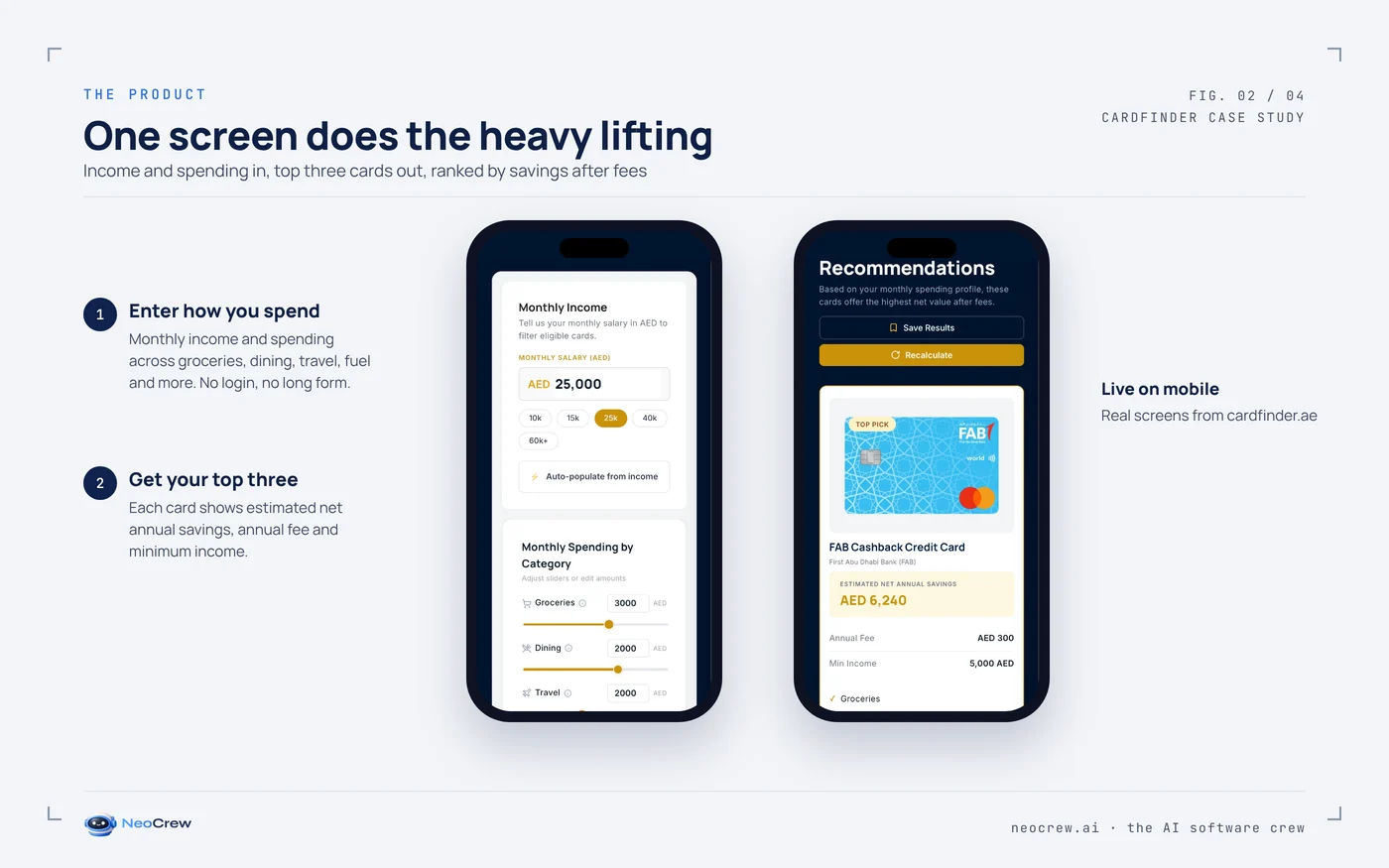
| How it works | Enter income and spending, get a top three. No login |
| How it was built | Four stages on NeoCrew AI, each approved by the founder |
| After launch | Results now go to the visitor’s WhatsApp, added as an update |
Why is choosing a credit card in the UAE so hard?
The UAE market is easy to get wrong. Three things make it hard:
- It is dense. Dozens of cards across more than a dozen banks, each with its own cashback categories and eligibility rules.
- The fine print moves. Cashback rates, fees and salary thresholds change often.
- Defaults win. Without a better answer, most people take the card their salary bank offers.
The founder wanted one place that gives a short, honest answer, and he wanted it in front of real users fast. That is the same instinct behind validating a startup idea before you spend a year building it.
How was CardFinder built?
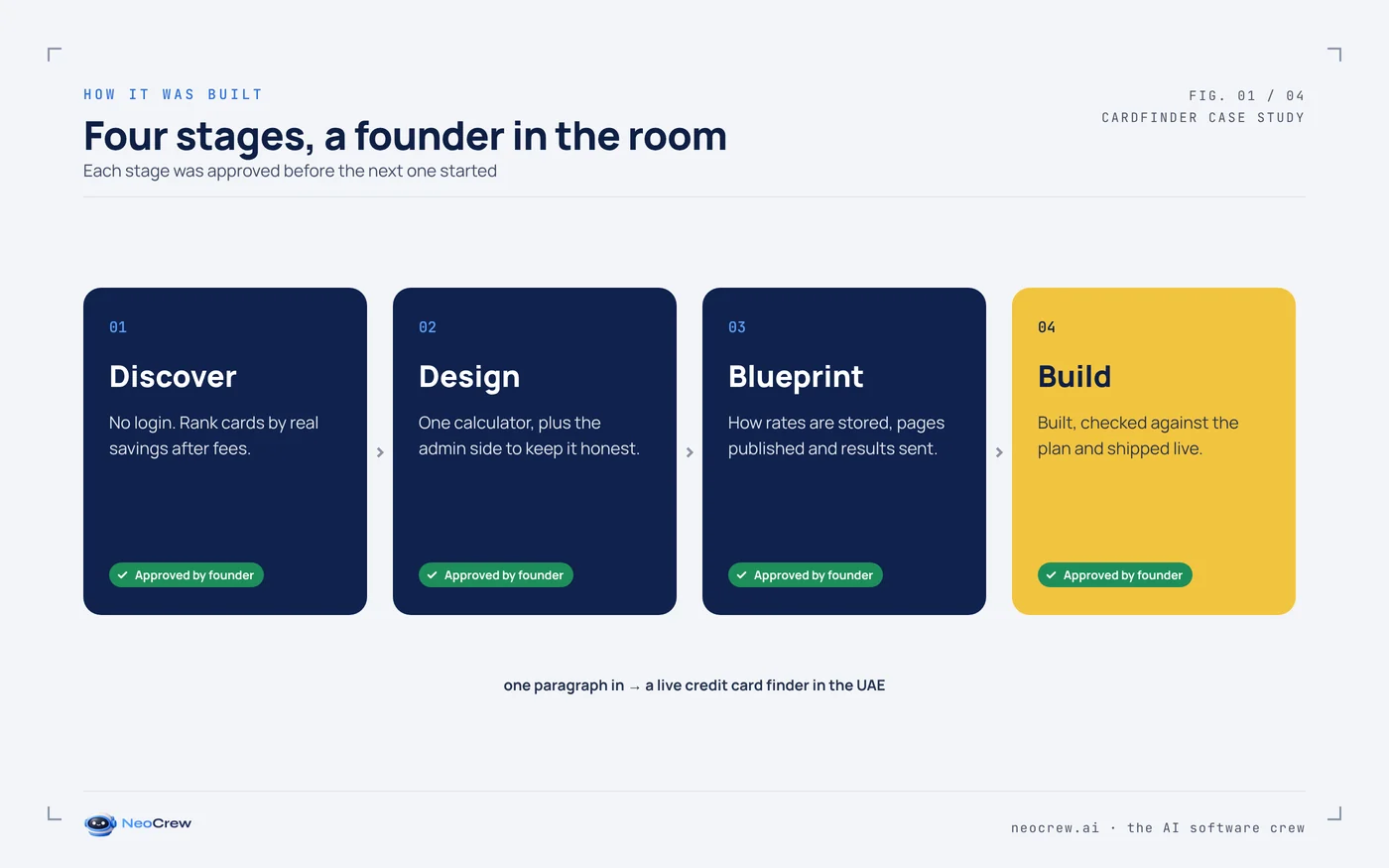
CardFinder went through NeoCrew’s four stages. The founder approved each one before the next started, so every big decision was made while it was still cheap to change.
Discover: decide what you are building
The first output was not a screen. In Discover, the idea became a product requirements document: the problem, who it is for, and what goes into version one. Two decisions made here shaped everything after:
- No login. A first-time visitor wants to know if this applies to them, without giving their email to ten banks.
- Rank by real savings. Cards are ranked by estimated net annual savings after fees, not by headline cashback.
The founder said this stage is what built his trust: the questions were asked from a founder’s point of view, not just a builder’s.
Design: one screen does the heavy lifting
The whole product rests on one calculator. In Design, it took shape: income and spending across groceries, dining, travel, fuel, shopping, utilities and car rental go in, and a top three comes out. Each card shows estimated savings, annual fee, minimum income and one plain line explaining the match.
Blueprint: agree how it works before any code
In Blueprint, the plan was signed off: how card rates are stored, how answer pages are published, and how results reach the visitor. The founder approved it, so there were no surprises in Build.
Build: ship it, then keep it running
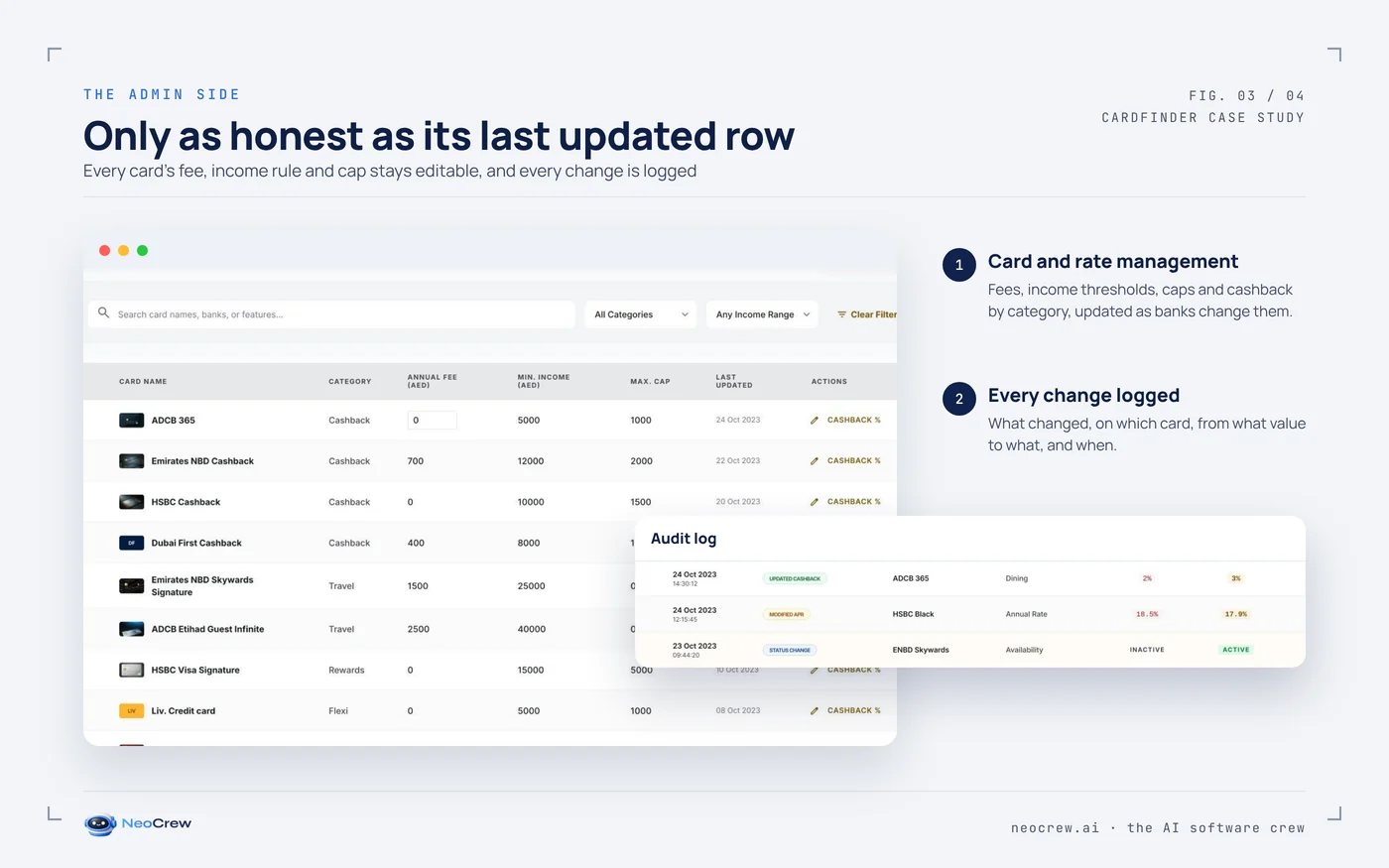
In Build, the product was built, checked against the approved plan and shipped as a live web app. Behind the calculator sits a proper admin side, not a spreadsheet, because a comparison tool is only as honest as its most recently updated row.
What changed after launch?
The first version ended each recommendation with an Apply Now button. Real users showed a better path. The live version ends with Get My Top 3 Cards on WhatsApp, which sends the results to the channel UAE residents already use, instead of an email they may never open.
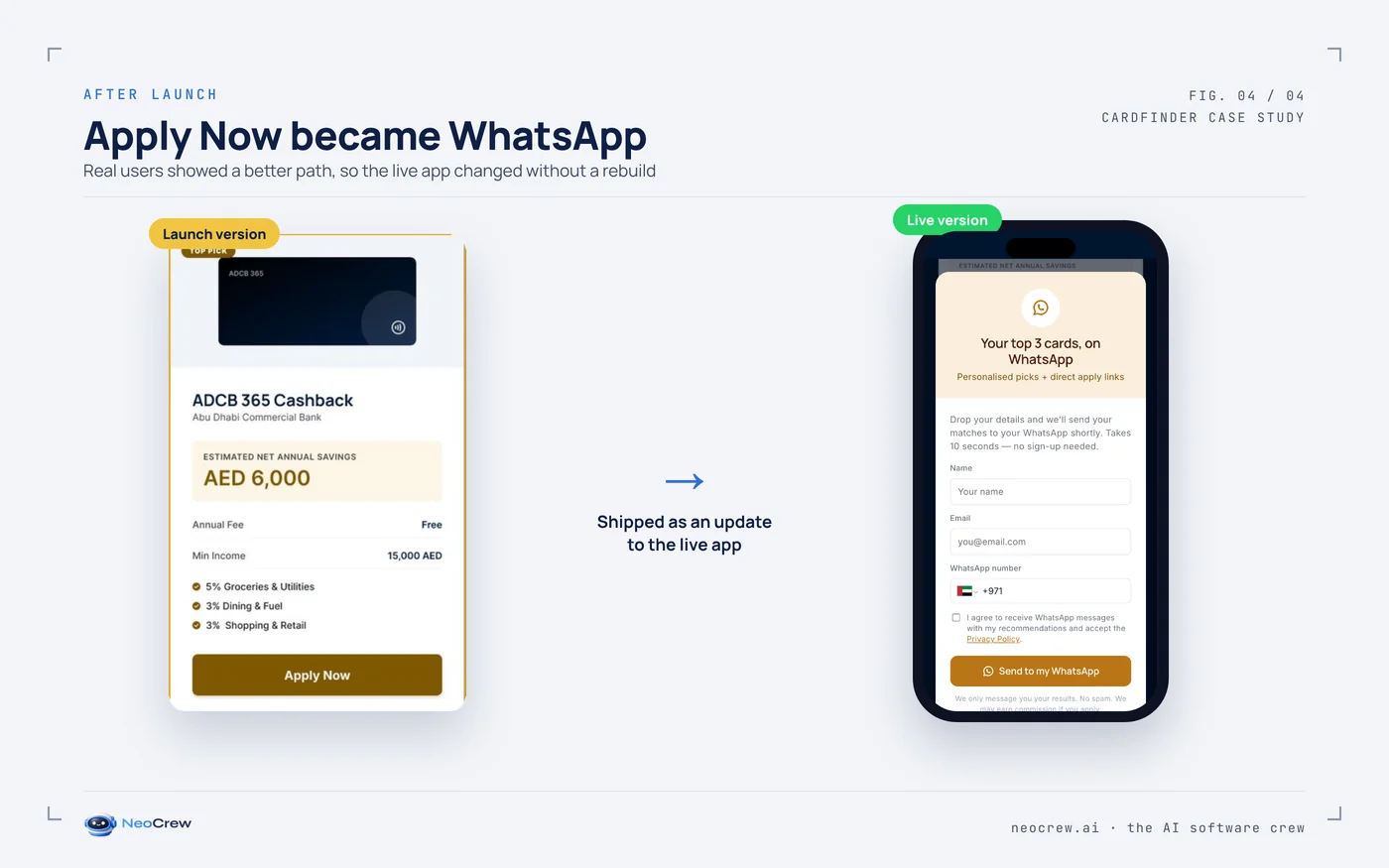
That change was added to the live app as an update. No second project, no new vendor, no starting over.
What can other founders take from CardFinder?
- Write the requirements first. The two biggest decisions (no login, rank by savings) were made on paper, when changing them cost nothing. See how to write a PRD.
- Design for the first visit. List the questions a stranger has in their first 30 seconds, and design every screen around them.
- Plan the admin side from day one. If your product depends on data that changes, the tools to update it are part of version one.
- Launch small, then learn. The WhatsApp change came from real users, not a planning meeting. That is the point of an MVP.
Keep reading
- The full CardFinder case study
- How to turn an app idea into requirements and designed screens with AI
- How to build an MVP in 2026: a step-by-step guide
- How much does it cost to build an app in 2026?
- Who maintains the code an AI wrote?
- Idea In. Live App Out. (Not a Repository.)
- White Label App Development for Agencies
Frequently asked questions
Can you build an app like CardFinder without a technical co-founder?
Yes. The founder of CardFinder did not build an in-house engineering team. He made the product decisions and approved each stage, and the app was delivered on NeoCrew AI through Discover, Design, Blueprint and Build.
What does CardFinder do?
CardFinder is a UAE credit card finder. A visitor enters their monthly income and how they spend, and it ranks the three credit cards with the highest estimated net annual savings after fees. There is no login, and the results can be sent to WhatsApp.
Can the app change after launch?
Yes. The launch version ended with an Apply Now button. The live version sends the top three cards to the visitor’s WhatsApp instead. That change was added to the live app as an update, not built as a new project.
Who keeps the app running after launch?
NeoCrew hosts and manages the app after launch. If you want it on your own servers instead, talk to us.