
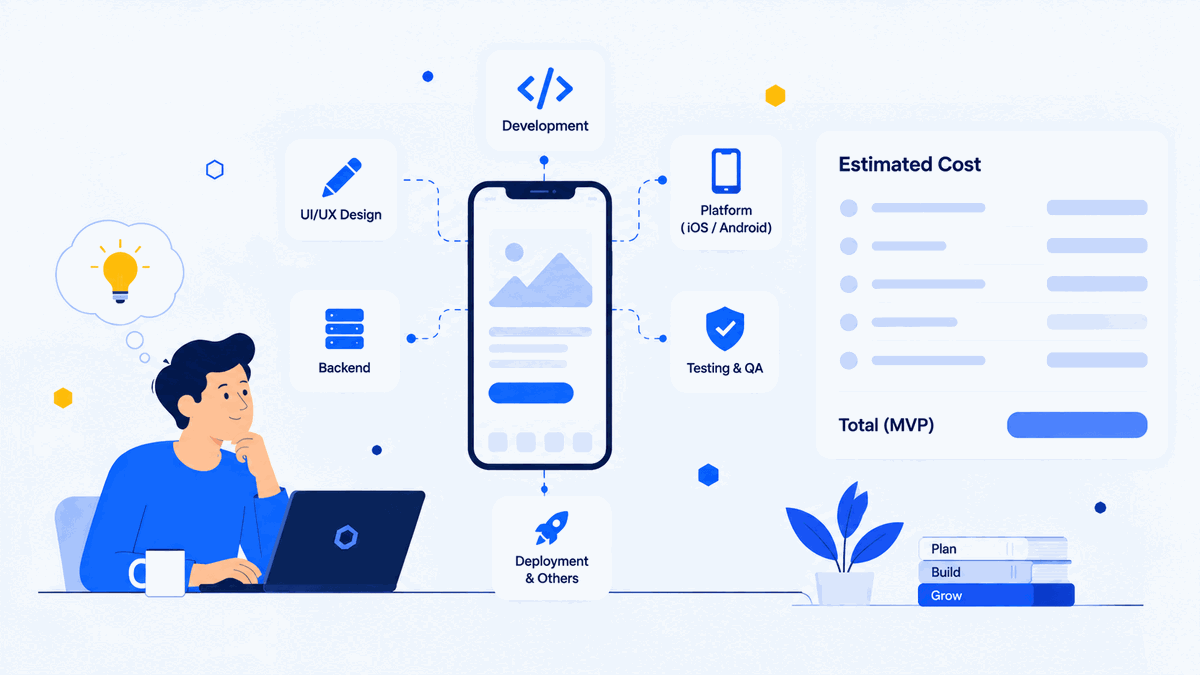
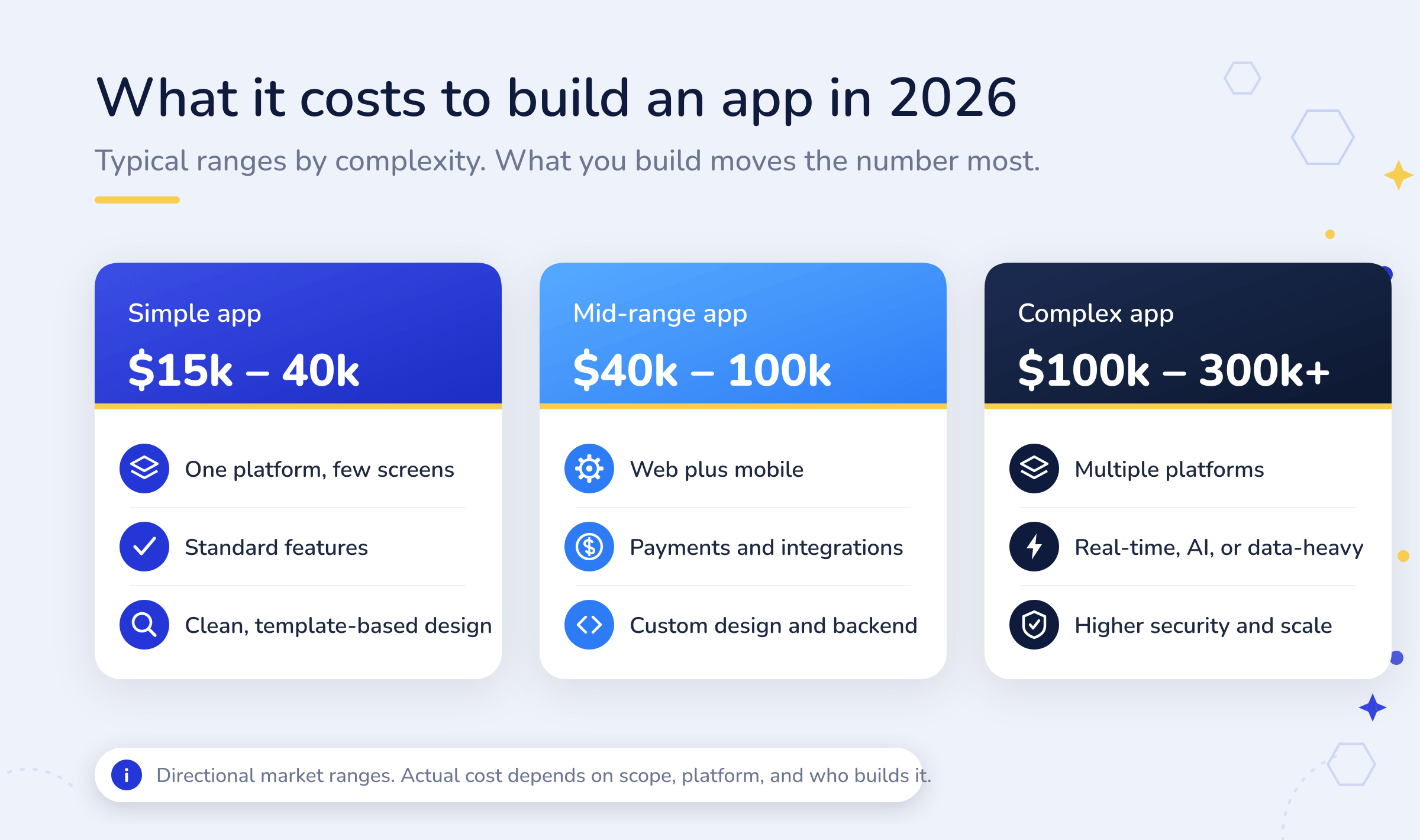
Building an app in 2026 typically costs between $15,000 and $300,000 or more, depending on complexity, platforms, and who builds it. A simple single-platform app sits at the low end. Costs rise with mobile apps, custom design, integrations, and complex or AI-heavy features. What you choose to build matters far more than where you build it.
That range is wide because an app is not one fixed thing with one fixed price. It is a set of choices, and each choice moves the number. This guide breaks down what actually drives the cost to build an app, what each budget tier gets you, how the build options compare, and where most people quietly overspend.
What goes into the cost of an app?
When people ask what an app costs, they usually picture the code. But the code is only part of it. The real cost is the sum of every decision about what the app does, who it serves, and how well it has to work. A to-do list for one platform and a marketplace with payments, chat, and real-time updates are both “apps”, and they are worlds apart in cost.
So the honest answer to what an app costs is: it depends, and the biggest variable is you. The scope you choose, the platforms you commit to, and the discipline you bring to the brief decide most of the final number before a single developer is involved.
It helps to separate two things people blur together: the app you imagine and the app you need to launch. The imagined app has every feature you can picture. The one you need to launch has only the features that prove someone will use it. The gap between those two is where most of the cost, and most of the waste, lives. Close it, and the price comes down without losing anything that matters.
What drives the cost of building an app?
Six things move the number more than anything else. Understand these and you can estimate, and control, an app build with your eyes open.
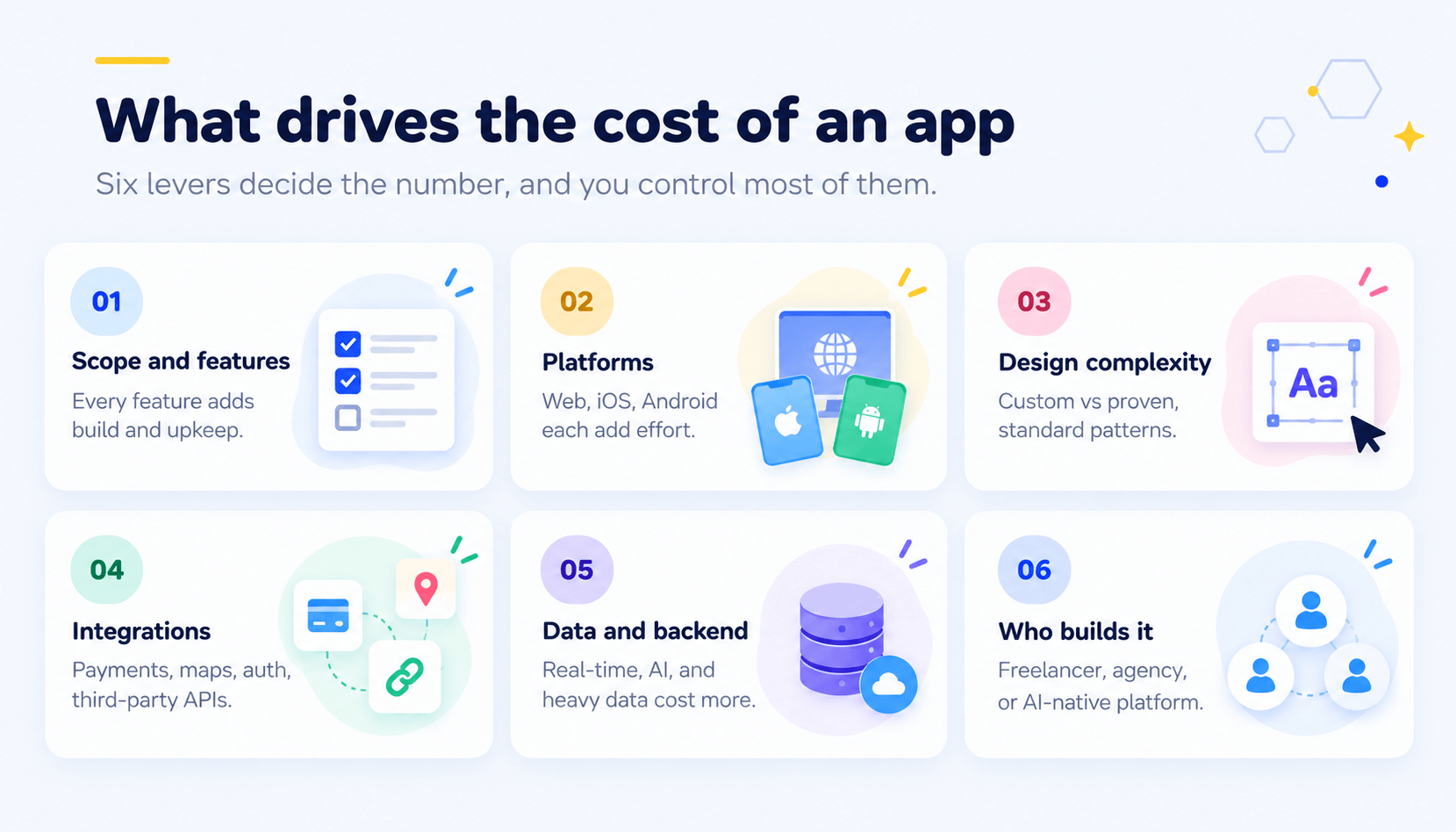
- Scope and features. The single biggest driver. Every feature adds design, build, testing, and ongoing maintenance. A five-feature app is not slightly cheaper than a fifteen-feature one, it is dramatically cheaper.
- Platforms. A single web app is the cheapest path. Adding native iOS and Android roughly multiplies front-end effort. Deciding this early, rather than mid-build, saves real money.
- Design complexity. A clean, standard interface on a proven design system is fast. Fully custom, animation-heavy design costs more and rarely changes whether the app succeeds.
- Integrations. Payments, maps, messaging, auth, third-party APIs. Each is real engineering, and some, like billing or compliance, carry ongoing complexity after launch.
- Data and backend. Simple apps store and fetch. Real-time features, heavy data, search, or AI push cost up because the backend has to do far more work.
- Who builds it. A freelancer, an agency, and an AI-native platform will quote very different numbers for the same brief, and deliver at very different speeds.
Notice that five of these six drivers are decisions you make, not prices the market sets. That is the good news hidden in a scary-looking range. You are not at the mercy of a quote. Trim the scope, commit to one platform first, and lean on proven design, and the number falls before a single builder is involved.
App cost by budget tier
Ranges are useful, but people want to know what a number actually buys. Here is roughly what each tier delivers, so you can match a budget to the outcome you need.
- Around $15,000 to $40,000. A focused, single-platform app. A handful of core features, standard sign-in, a clean interface, and the one workflow that proves your idea. Enough to put a real product in front of real users.
- Around $40,000 to $100,000. A more complete product. Web plus mobile or a richer feature set, payments and key integrations, custom design, and a backend built to grow. The right tier when the app needs to feel polished from day one.
- Around $100,000 to $300,000 and up. A complex or regulated build. Multiple platforms, real-time or AI-driven features, heavy data, and stronger security. Appropriate once the core idea is validated and the risk is in execution, not demand.
How long does it take to build an app?
Cost and time move together, because most of the price is people’s hours. As a rough guide, a simple app is often a matter of weeks, a mid-range app a few months, and a complex app six months or more with a traditional team. The single biggest factor is the same one that drives cost: how much you choose to build. A tighter scope is both cheaper and faster.
This is where the build approach matters most. AI-native delivery can compress the timeline significantly, because AI agents handle much of the build that would otherwise take a team weeks. A focused app that might have taken a quarter can land much sooner, as long as the scope stays disciplined and a human is reviewing each stage.
Who should build your app: freelancer, agency, or platform?
The same app costs very differently depending on who builds it. A freelancer is usually the cheapest sticker price and can suit a small, well-defined build, but cost and quality vary with the individual, and coordination falls on you. An agency brings a full team and process, which is why agencies sit at the high end; for a large, funded build that is often worth it. An AI-native platform takes a different shape: AI agents do the heavy lifting while a human approves each stage, which compresses cost and time. For most people trying to get a validated app built quickly and affordably, it is the newest and often the most efficient option.
The right answer depends on your stage, not on which option is cheapest on paper. A tiny, one-off build can suit a freelancer. A large, funded programme can justify an agency. But for the common case, someone who needs to prove an idea fast without burning the budget, an AI-native platform tends to give the best balance of cost, speed, and control. And whichever you pick, the decision is reversible: you can start lean and change approach as the app grows.
The cost most people forget: after launch
An app quote is a one-time number, but software is not a one-time cost. Once your app is live it needs hosting, third-party service fees, security updates, bug fixes, and changes based on how people use it. Plan for ongoing costs every year on top of the initial build, covering infrastructure and maintenance.
People who budget only for the build are caught out by this, and it is another reason to keep scope lean. Every feature you ship is not just a build cost, it is a maintenance cost that recurs for as long as the feature exists. A smaller, sharper app is cheaper to run, not only cheaper to build.
A useful habit is to budget for the first year, not just the launch. Add the expected running costs to the build number before you decide what you can afford, and the picture changes. Suddenly a leaner first version is not a compromise, it is the sensible choice, because it costs less to build and less to keep alive while you find out whether the app deserves more.
The most expensive mistake: building the wrong app
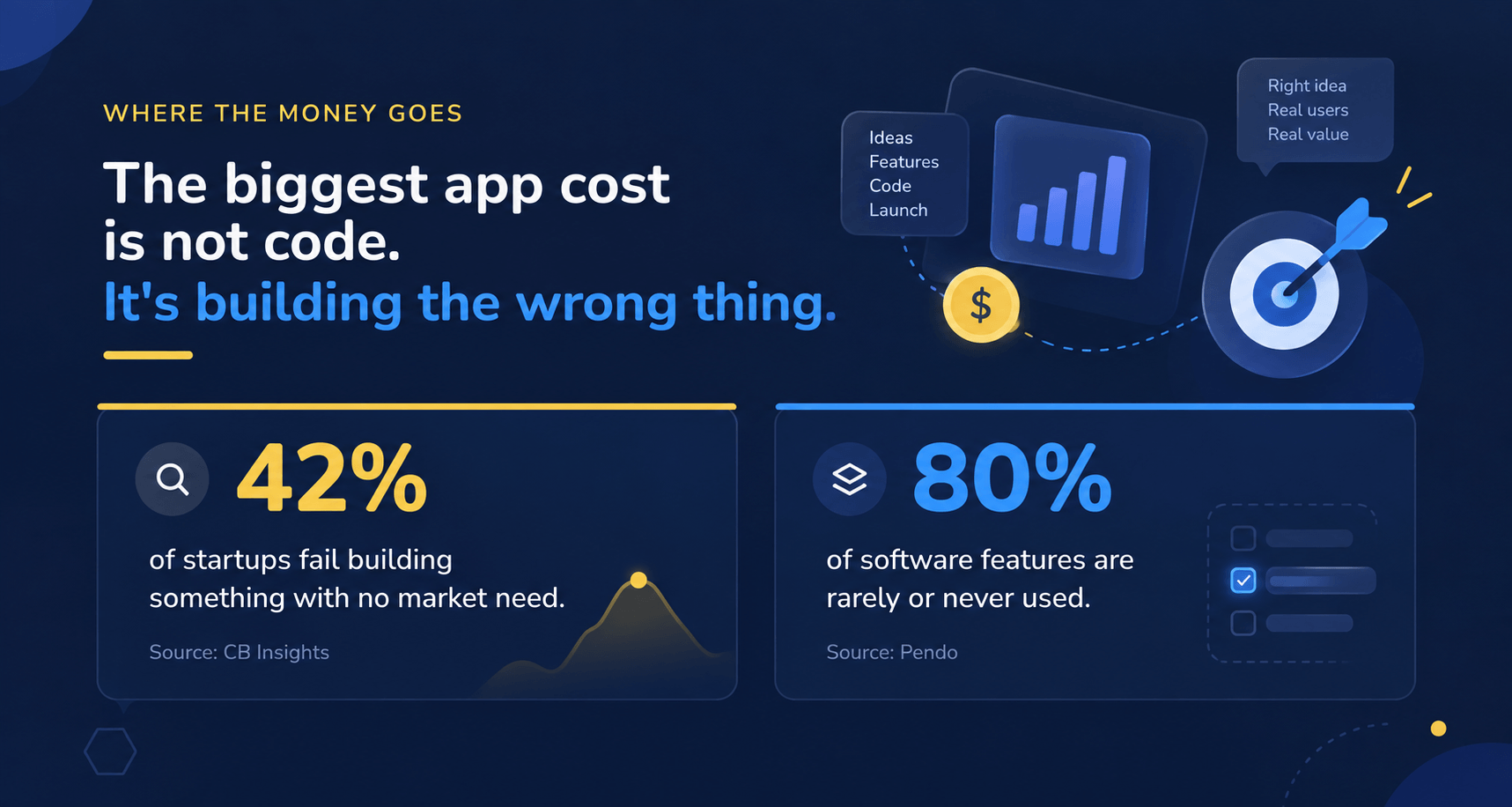
The most expensive line in an app budget is rarely a feature you can see. It is the features nobody uses, and the app nobody wanted. Pendo found that 80 percent of software features are rarely or never used, and CB Insights found that 42 percent of startups fail because they build something with no market need. Both are ways of spending your budget on the wrong thing.
The cheapest app is the one that tests your riskiest assumption first, and nothing else. Before you commit a big budget, it is worth reading how to keep a first build lean, whether that is understanding what it costs to build an MVP or how to build one step by step. The leaner your first version, the faster and cheaper you learn whether the full app is worth building.
How to reduce the cost of building an app
Lowering the cost of an app is not about finding a cheaper builder. It is about building less, in the right order. Five habits do most of the work.
- Validate before you build. Confirm people want it before you spend. It is the cheapest insurance there is.
- Start with an MVP. Build the core first, launch, and let real usage tell you what earns the next dollar.
- Pick one platform to start. Launch where your first users are. Add platforms once the idea is proven.
- Rank features ruthlessly. Split them into must-have, should-have, and later. Build only the must-haves.
- Keep a human approving each stage. Catching a wrong turn early costs an afternoon. Catching it after the build costs a rebuild.
How AI is changing app development cost
AI has changed app economics more than any shift in years. Coding assistants speed up developers, and AI-native platforms can take a clear brief and build much of the app with far less manual effort. The floor for a credible app is lower than it was, and the timeline is shorter. The catch is that AI can build the wrong app just as fast as the right one, so validation and lean scope matter more, not less. Speed only helps when it is pointed at something worth building.
For someone paying the bill, the practical effect is simple. The cost of a first version has fallen, and the excuse of a long, expensive build has largely gone. What remains is the part that always mattered most: deciding what to build. Spend your energy there, on scope and validation, and let the tools handle the rest, and you will spend far less to learn whether your app is worth building at full scale.
Where NeoCrew fits
NeoCrew is built for people who want an app built without a full team or an agency-sized budget. It starts by turning your idea into a clear, ranked plan in the Discover stage, so scope is decided before money is spent. From there, AI agents design, plan, and build, which keeps cost and timeline down compared with traditional delivery.
It is a fit for founders building their first product, where every week of runway counts. And because the build happens stage by stage with your approval at each gate, you only pay to build what you have actually decided you need. No surprise scope, no bloated invoice.
Frequently asked questions
How much does it cost to build an app in 2026?
Most apps cost between $15,000 and $300,000. A simple, single-platform app with a few core features usually lands in the low tens of thousands. Cost rises with extra platforms, custom design, integrations, and complex or AI-driven features.
Why do app cost estimates vary so much?
Because an app is a set of choices, not a fixed product. Scope, number of features, platforms, design, integrations, and who builds it each move the number significantly. Two teams can quote very different prices for the same idea.
How much does it cost to build a mobile app specifically?
Mobile apps often cost more than a single web app because native iOS and Android are effectively two front-ends. A simple mobile app can start in the tens of thousands; a complex, multi-platform one runs well into six figures.
Is it cheaper to build an app with a freelancer, an agency, or a platform?
A freelancer usually has the lowest sticker price but the highest variance. An agency costs the most because you pay for a full team and process. An AI-native platform can compress cost and time while keeping a human approval gate on quality.
What is the most common way people overspend on an app?
By building features nobody uses. Research shows 80 percent of software features are rarely or never used, so every unused feature is wasted budget. The cheapest app tests the riskiest assumption first and little else.
How can I reduce the cost of building my app?
Validate before you build, start with an MVP, launch on one platform first, rank features and build only the must-haves, and keep a human approving each stage so wrong turns are caught early, when they are cheap to fix.
Turn your idea into an app
Describe the app you want to build, and NeoCrew’s AI crew scopes it, prices it, and builds it stage by stage. You approve each step before it moves, so you only pay to build what you actually need. Start in the Discover stage.