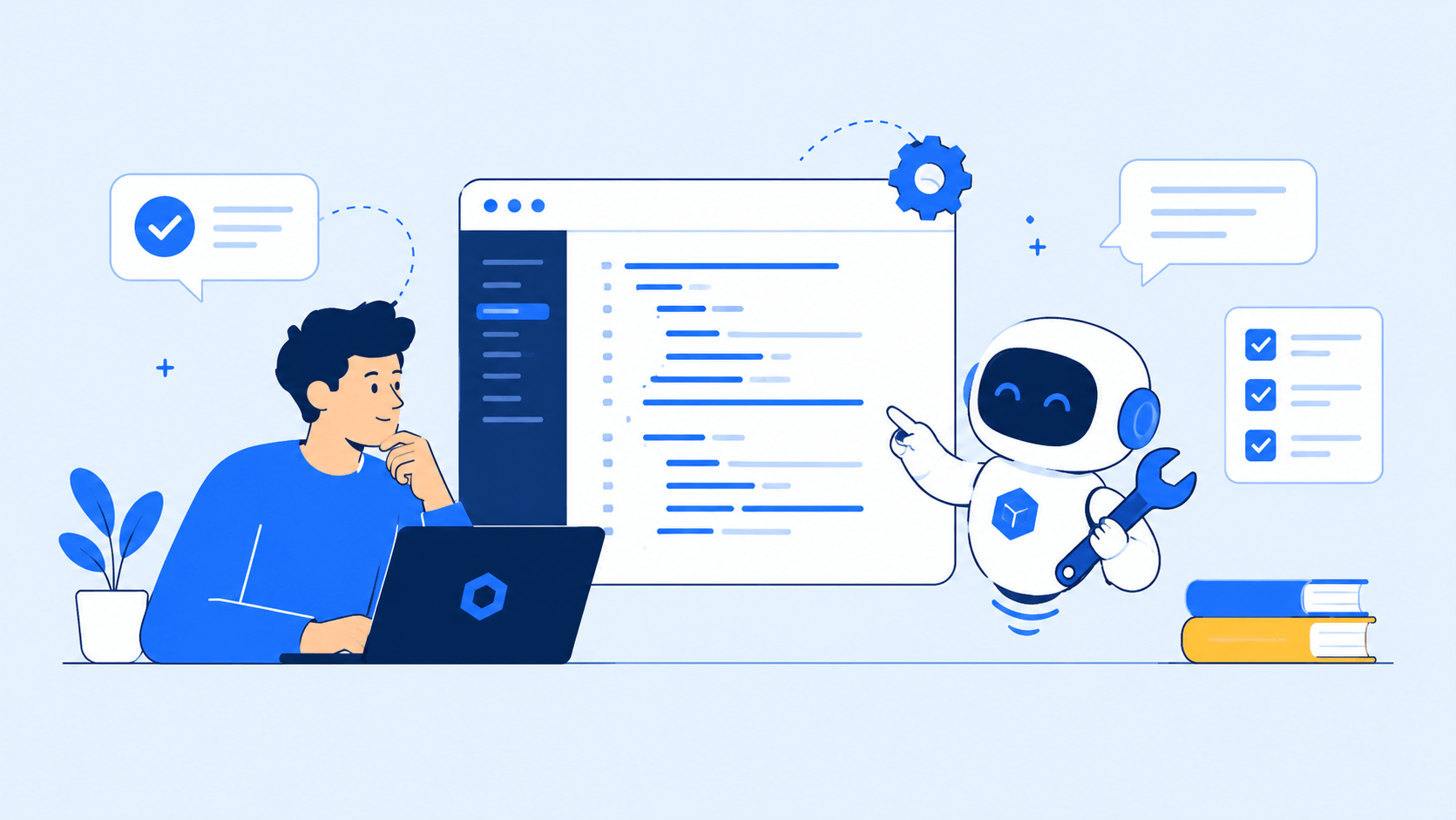
The honest answer is that usually nobody does, and that is the problem. AI can generate code in seconds, but someone still has to understand it, fix it, and extend it for years. Without a way to reproduce failures, guard against regressions, and hold the app to a fixed contract, AI-written code becomes technical debt with no clear owner.
Writing code was never the expensive part of software. Keeping it working, safely, over years, is. As AI makes generating code almost free, the maintenance question stops being a detail and becomes the whole game. This piece looks at what happens to AI-written code after it ships, why so much of it is hard to maintain, and the three guarantees that decide whether anyone can ever safely change it.
What happens to AI-written code after it ships?
The uncomfortable truth is that a lot of it becomes an orphan. It works on the day it ships, so it goes live. Then a bug appears, or a requirement changes, and someone has to open code that no human ever really wrote, understood, or structured. The person who prompted it did not design it, and the model that produced it is not around to explain it. The result is code that is cheap to create and expensive to touch.
This matters most for the people who were sold on speed. A founder who used a tool to ship fast now owns software nobody on the team can confidently change. The first serious bug becomes a crisis, not because the bug is hard, but because touching the code safely is. Speed at the start quietly borrows against every change that comes after, and the loan comes due the first time the product has to grow.
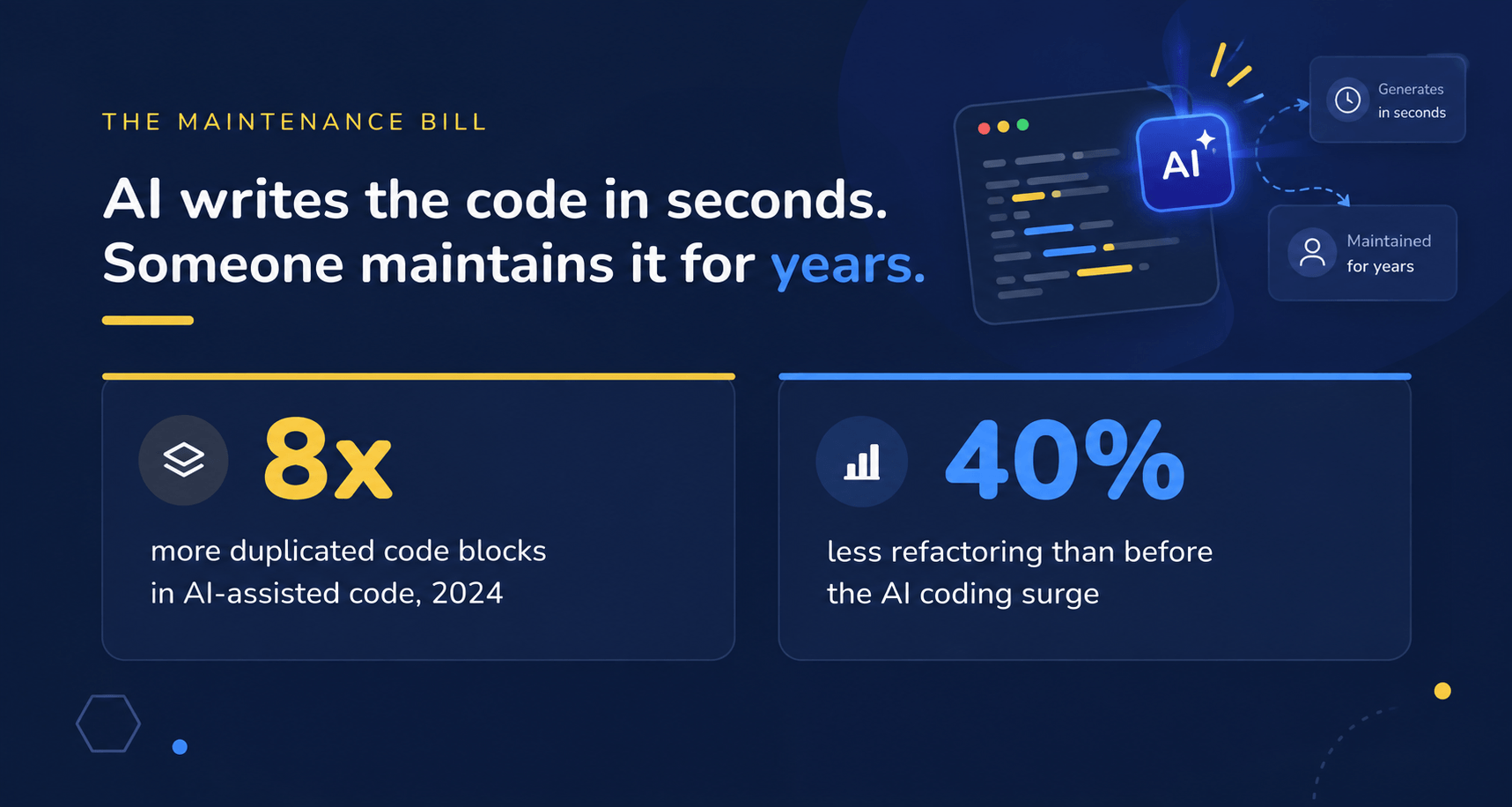
The data backs up the instinct. GitClear’s 2025 research, drawn from 211 million lines of code, found that duplicated code blocks rose roughly eightfold in 2024, while refactoring, the ongoing work of keeping code clean, fell by about 40 percent as AI assistants took hold. More code is being produced, less of it is being tidied, and more of it needs rework soon after it is written. That is the shape of debt accumulating.
Why AI-generated code is hard to maintain
AI models generate from patterns, not from your project. They do not know your existing modules, your shared utilities, or the abstractions your codebase already relies on, so they tend to duplicate rather than reuse. Duplicated code is not just untidy; cloned blocks are linked to markedly more defects, because a fix applied in one place quietly leaves the copies broken.
There is also the matter of intent. When a person writes code, they carry a mental model of why it is shaped the way it is, and that model, however imperfectly, survives in naming, structure, and comments. Generated code arrives without that context. It is a plausible answer to a prompt, not a considered part of a system, so the next person has to reverse-engineer intent that was never really there. That missing why is a large part of what makes maintenance slow and risky.
There is a subtler trap too. Generated code can pass every test in the suite and still be wrong. Tests usually check the behaviour someone thought to specify, and AI-written code often breaks behaviour nobody thought was at risk. A codebase can show high line coverage and still ship real bugs, because covering which lines executed is not the same as verifying that the product actually does what it should. When nobody can reliably say what the app is supposed to do, nobody can safely change it.
The real question is not who wrote it, but who can change it
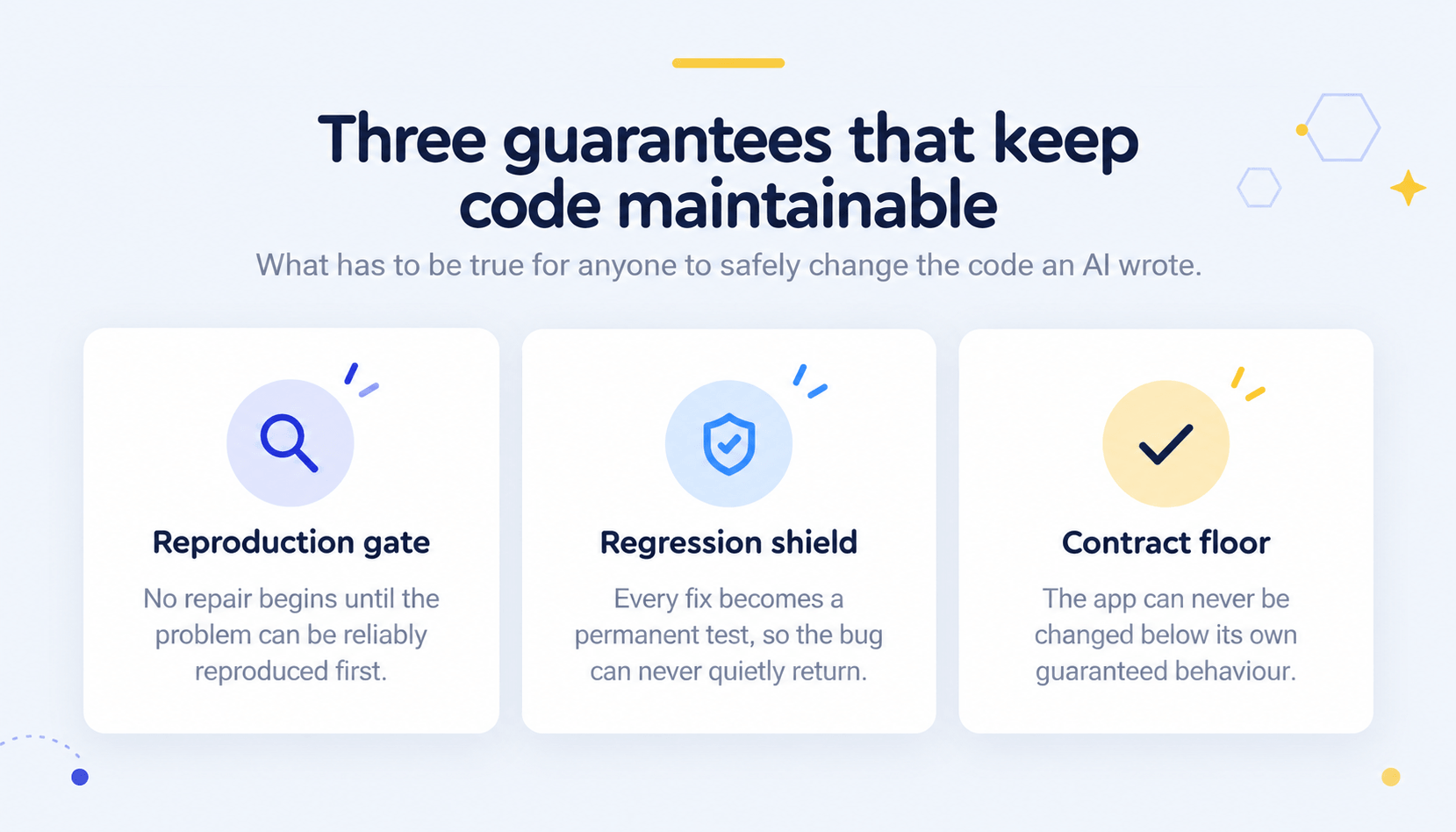
This reframes the whole issue. “Who maintains the code an AI wrote” is really “who can safely change this code without breaking something else.” And the answer does not depend on who typed it. It depends on whether the code comes with the machinery that makes safe change possible. Three things have to be true. Miss any one of them, and maintenance becomes guesswork.
None of the three is exotic. They are practices good engineers have used for decades, long before AI wrote a line. What has changed is the stakes. When code is generated fast and in volume by something that will not be there to explain it later, these guarantees stop being nice-to-have hygiene and become the only thing standing between you and an unmaintainable product. The tools that generate code rarely include them. That gap is the whole story of this article.
The reproduction gate
You cannot fix what you cannot reproduce. The reproduction gate is a simple, strict rule: no repair begins until the problem has been captured as a reliable, repeatable failure, usually a failing test that demonstrates the bug on demand. It sounds obvious, and it is routinely skipped, especially with generated code where the temptation is to prompt a patch and hope. The gate forces understanding before action. If you cannot make the bug happen on purpose, you do not yet understand it well enough to fix it, and any change you make is a guess.
The gate also protects against a specific failure mode of AI repairs: a fix that makes the reported symptom disappear without addressing the cause. When a bug is pinned down as a repeatable test, the fix has a clear, verifiable target, and you can prove the problem is actually gone rather than merely hidden. Without that, generated patches tend to paper over symptoms and leave the real fault waiting to resurface somewhere less convenient.
The regression shield
Once a bug is reproduced and fixed, the test that captured it does not get thrown away. It stays, and joins a growing suite that acts as a shield. From that point on, if any future change would bring the bug back, the shield catches it before it ships. This is what stops maintenance from being a game of whack-a-mole, where every fix risks reopening an old wound. Each repair makes the shield stronger, so the codebase gets safer to change over time rather than more fragile, which is the opposite of how orphaned AI code usually ages.
This is also what makes an AI safe to point at a codebase for repairs. An agent making changes is far less frightening when a comprehensive shield sits underneath it, because anything it breaks that was previously guaranteed is caught immediately. The shield turns “we hope the change was safe” into “we can prove nothing we cared about broke,” which is the only basis on which fast, automated change is responsible at all.
The contract floor
The third guarantee ties the first two together. An application has a contract: the set of behaviours it is required to deliver, captured as tests and specifications. The contract is a floor. No change, no repair, no new feature is allowed to take the app below it. You can raise the ceiling all you like, but you can never drop through the floor.
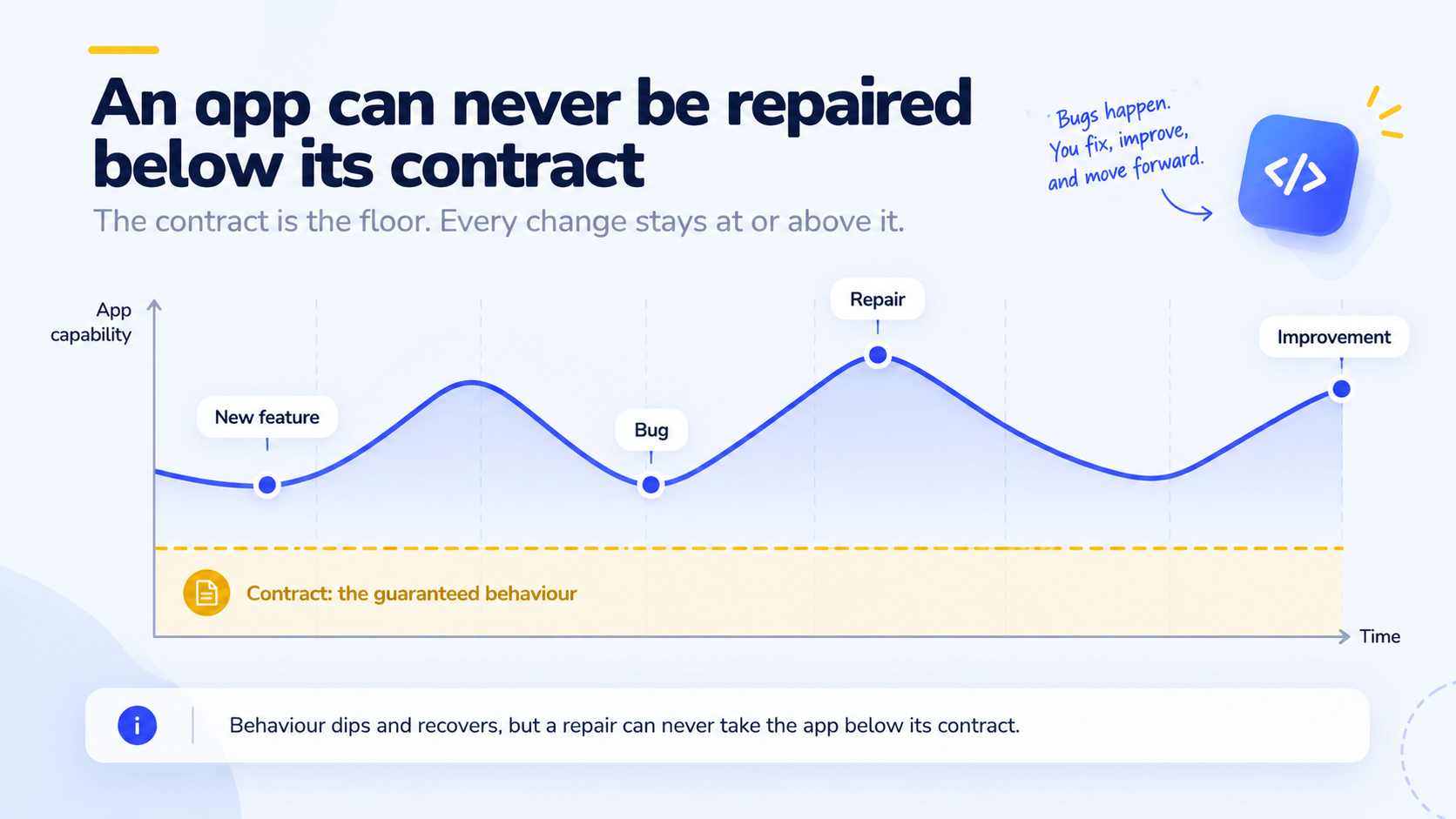
This is the guarantee that changes everything about maintaining AI-written code. Without a contract, every change is a gamble against behaviour nobody wrote down. With one, the app can be repaired, extended, and refactored freely, because the floor holds no matter who, or what, is doing the work. An application can never be repaired below its own contract, and that single property is what makes generated code safe to own.
What AI technical debt actually costs
Skip these guarantees and the bill still arrives, just later and larger. AI technical debt is the compound interest on code that was cheap to write and hard to keep. It shows up as duplicated logic that multiplies bugs, as fixes that reopen old problems, and as a codebase that gets slower and riskier to change until progress grinds down. Industry research through 2025 has consistently found that teams spend more time debugging and securing AI-generated code than the raw speed of generation would suggest, which is exactly what unmanaged debt looks like.
The trap is that none of this is visible on launch day. The prototype works, the demo lands, the invoice is paid. The cost is deferred, and it lands on whoever inherits the code when the first real change is needed. Paying a little up front to keep code maintainable is almost always cheaper than paying a lot later to untangle code that nobody can safely touch.
It compounds, too, which is the dangerous part. Duplicated logic breeds more duplication as the next AI change copies the pattern it finds. Untested behaviour invites more untested behaviour. A codebase without a contract drifts further from any definition of correct with each change, until “what is this app supposed to do” has no answer anyone can point to. Debt left alone does not stay still; it grows, and the interest is paid in every future hour of development.
How to keep AI-written code maintainable
The fix is not to write less AI code. It is to insist that whatever produces it also produces the machinery to maintain it. Five practices carry most of the weight.
- Demand reproducible failures. No fix without a test that reproduces the problem first. Make it a rule, not a preference.
- Keep every regression test. Fixes should add permanent guards, so the suite grows into a shield instead of decaying.
- Define the contract explicitly. Write down the behaviour the app must always deliver, so there is a floor to hold changes to.
- Test behaviour, not just lines. Coverage of what the product does matters more than coverage of which lines ran.
- Have a different reviewer than the author. Code should be checked by something other than the tool that wrote it, a point worth a whole discussion of its own.
Where NeoCrew fits
NeoCrew was built by a team who spent fifteen years shipping software the hard way, then built the thing they wished existed. The maintenance problem is one they know well, which is why these guarantees are not an afterthought on the platform; they are how it builds. NeoCrew’s AI agents work against a defined contract, gate repairs behind reproducible failures, and grow a regression shield as they go, all under human approval.
The point is ownership you can trust. Because the build runs stage by stage with the contract holding underneath, the code an AI wrote does not become an orphan. It can be reproduced, repaired, and extended safely, and it can never be dropped below the behaviour it guarantees. That is the difference between generated code you are stuck with and a product you actually own.
Frequently asked questions
Who is responsible for maintaining AI-generated code?
Whoever owns the application, not the tool that generated it. The AI is not around to explain or fix its output later, so responsibility falls to the team that ships and runs the software. That is why the code needs to be maintainable by design, not just functional on launch day.
What is AI technical debt?
It is the long-term maintenance burden created when AI generates large volumes of code without the discipline that keeps code clean. It shows up as duplication, low reuse, and code that needs frequent rework. GitClear’s 2025 research found duplicated code blocks rose about eightfold in 2024 while refactoring dropped roughly 40 percent.
Can AI-generated code be maintained safely?
Yes, but only if it comes with the machinery for safe change: reproducible failures before any fix, permanent regression tests, and a defined contract of behaviour the app can never drop below. Without those, generated code is difficult and risky to change, regardless of who wrote it.
Why is AI-generated code harder to maintain than human code?
AI generates from patterns rather than from your codebase, so it tends to duplicate instead of reuse, and it can pass existing tests while breaking behaviour nobody specified. Both make the code harder to understand and riskier to change later.
What is a regression shield?
It is the growing suite of tests formed by keeping every test that once reproduced a bug. Once a fix is in, its test stays and guards against the bug ever returning, so the codebase becomes safer to change over time rather than more fragile.
What does it mean that an app cannot be repaired below its contract?
The contract is the set of behaviours the application must always deliver, captured as tests and specifications. It acts as a floor: any repair or change must keep the app at or above it. Behaviour can improve, but a change can never take the app below its guaranteed contract.
Build software you can actually maintain
Generated code is only worth having if you can safely change it later. NeoCrew’s AI agents build against a contract, with reproducible fixes and a regression shield, so the product stays yours to maintain. See how NeoCrew builds.