Quick answer: Most AI coding tools generate code fast but leave you to prove it works, remember what was agreed, and keep it running after launch. NeoCrew is an agentic pipeline of specialised AI roles, with a human approval gate at every handoff and acceptance tests the building AI cannot see or edit, that takes an idea all the way to a live, monitored, proven application. You ship work, not seats.
Ask anyone who has shipped real software what the expensive part was. It was almost never the typing.
It was the business analyst interviewing stakeholders and writing requirements. The designer turning those requirements into screens. The architect turning the screens into a system. The developers turning the system into code, the testers deciding whether the code actually did what the requirements said, and the engineer keeping it alive once real users arrived.
Requirements, designs, architecture, code. Every one of those arrows is a person reading one document and rewriting it as another. Every rewrite loses a little fidelity. Multiply that across months and teams, and you arrive at the real price of software, not code, but coordination.
AI was supposed to collapse that cost. So far, it has collapsed exactly one arrow: the typing.
What do today’s AI coding tools actually do?
The current generation of AI coding tools is genuinely good. We use them. We admire them. And every one of them, without exception, is an assistant inside a process a person still runs.
They come in three broad shapes, and each is excellent at its job:
| Category | What it does well | What it still leaves to you |
|---|---|---|
| Inline assistants | Complete and refactor code inside your editor | The plan, the proof, the operations |
| Agentic coders | Read a repository, plan, edit files, run commands | A verdict the builder can’t influence; memory across stages |
| Prompt-to-app builders | Turn a description into a working prototype | Hosting and repair held to an approved plan |
Look down that right-hand column and you’ll see the same four gaps appear again and again:
- An approved plan to build against. In most tools, “correct” means whatever the prompt said. There is no document both sides signed before the work started.
- A verdict the builder can’t influence. When the same AI writes the code and the tests, “the tests pass” is the builder grading its own homework.
- Memory across stages. What the requirements conversation decided rarely survives into the architecture, and almost never into the fix applied weeks after launch.
- Hosting, monitoring and repair held to the plan. A prototype nobody keeps alive, or one that gets “fixed” into something the original plan never described, is not a product.
Some tools now cover one of these well. We have yet to find one that links all four into a single chain: one approved plan, carried through to a proven, live, repaired application.
That chain is the product we built.
Why is coordination, not code, the real cost of software?
Picture the children’s game of telephone. A sentence is whispered from person to person, and by the last ear it has mutated beyond recognition. Enterprise software is telephone played with documents, under deadline, across disciplines that each speak a different dialect.
The stakeholder says what the business needs. The analyst writes it down. The designer interprets the writing. The architect interprets the design. The developer interprets the architecture. Each translation is a competent professional doing their best, and each one quietly drops, adds, or bends a detail. The bug that surfaces in production was very often born as a misread sentence in week one.
Faster code generation does nothing for this. If anything, it makes it worse: now you can produce more code, faster, from a plan nobody formally agreed to, verified by nobody independent. Speed without structure just reaches the wrong destination sooner.
What is NeoCrew’s thesis?
Here is the uncomfortable truth behind every high-functioning software team: they ship because of their structure, not because of one brilliant person.
A real team works in stages, analyst, designer, architect, developers, testers, with a review gate between every handoff. Those gates are not bureaucracy. They are the mechanism that stops a misunderstanding in week one from becoming a rewrite in month three.
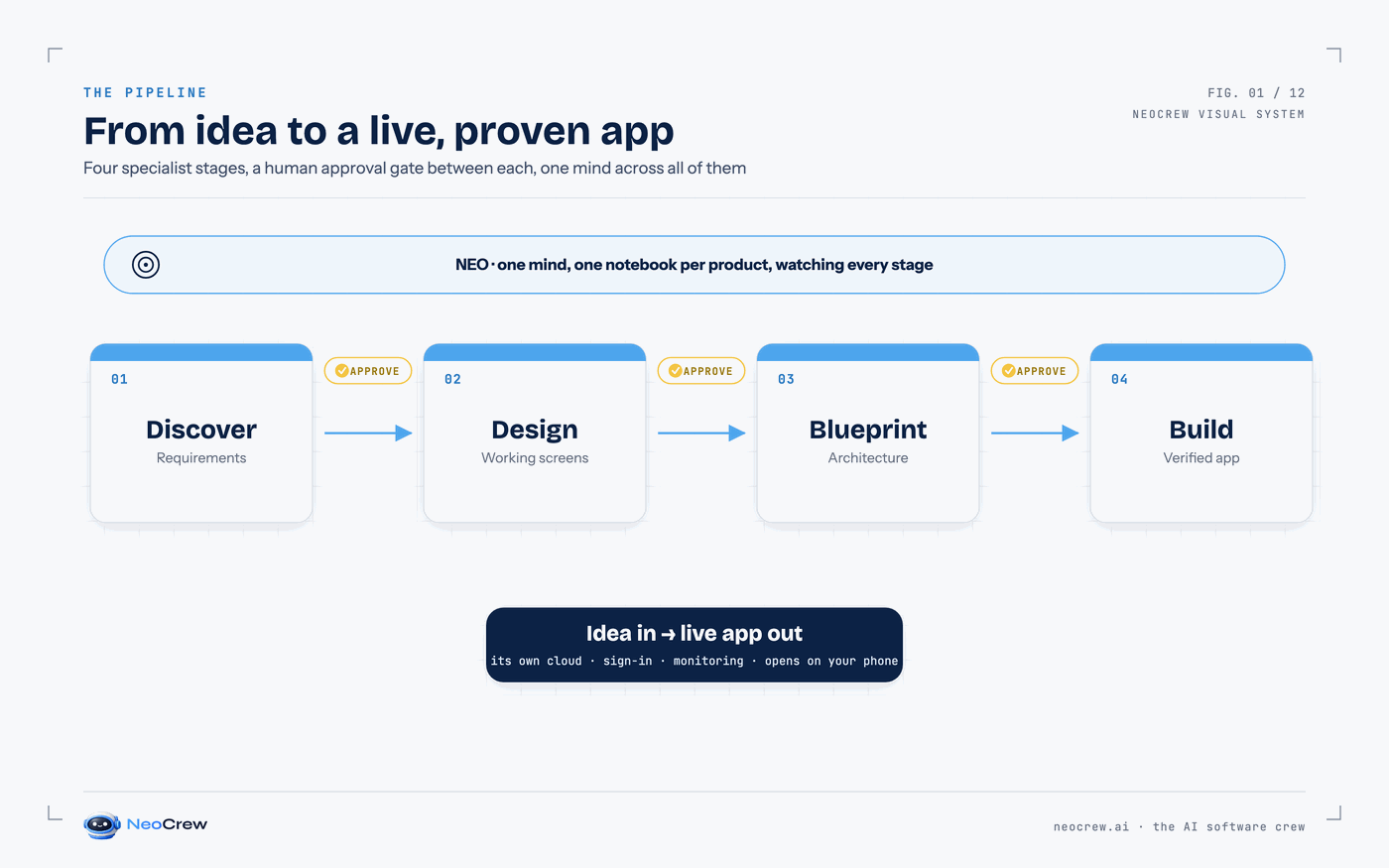
NeoCrew encodes that structure into an agentic pipeline:
- Every stage is specialised. One crew member does requirements. Another does design. Another does architecture. Another builds.
- Every handoff is a structured artifact, not a chat transcript. A requirements document. A design file with working screens. An architecture file. Work orders. Versioned, machine-readable, nothing lost in translation.
- Every stage is gated by human approval. A person signs off before the next stage begins, a handful of clear decisions, each presented with a recommendation.
- “Done” is decided by tests the builder cannot see, write, or edit. Acceptance tests are generated from the approved plan before the build starts, and kept where the building agent can’t reach them. Only a clean-room run counts.
That last point deserves its own line, because it is the heart of everything:
Our coding AI cannot grade its own homework.
How is NeoCrew different from a chat-based coding tool?
The easiest way to feel the difference is an analogy.
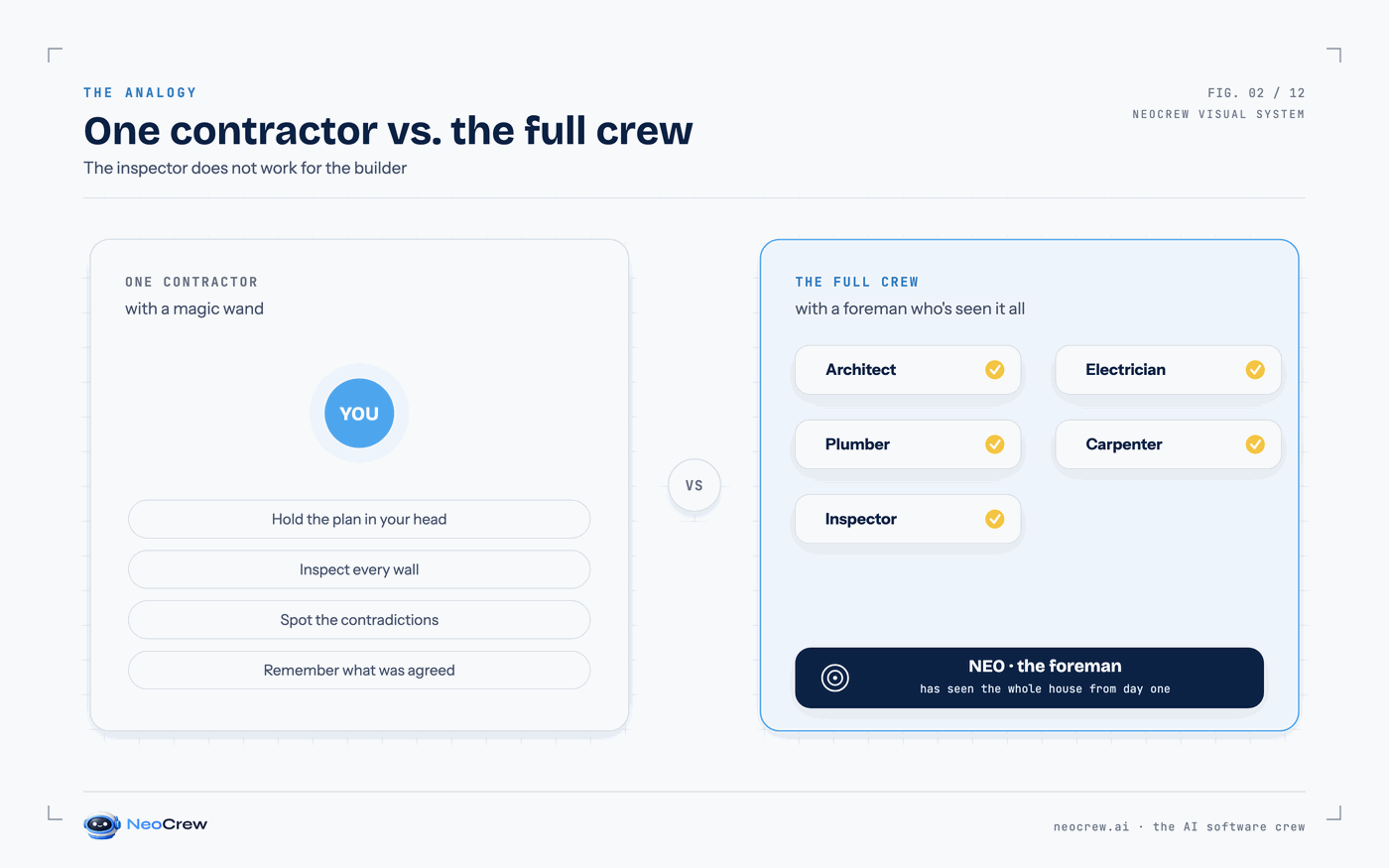
A chat-based coding tool is one contractor with a magic wand. Astonishingly fast, surprisingly capable, and you are the general contractor. You hold the plan in your head. You inspect every wall. You notice when the wiring contradicts the plumbing. You are the only one who remembers what was agreed back in the first meeting.
NeoCrew is the full construction crew: an architect, an electrician, a plumber, a carpenter, an inspector, each doing their own job, with sign-offs between them. And one role that matters most of all: a foreman who has seen the whole house from day one.
Ours is called NEO.
NEO reads every stage, keeps one notebook per product, reviews each handoff from the product’s point of view, and settles engineering disputes so you never have to. It asks the owner about exactly three things: product, money, and shipping. Everything else, the crew sorts out among itself, inside the gates.
What do you actually get at the end?
The output of NeoCrew is not a repository you now have to figure out how to run. It is a live application. Here is how the four pillars hand work down the line:
| Pillar | Role | What it produces |
|---|---|---|
| Discover | Requirements analysis | A stakeholder-ready requirements document |
| Design | UI/UX design | Responsive, working screens and a design system |
| Blueprint | Technical architecture | An owner-approved blueprint and a full low-level design |
| Build | Build, verify, deploy, maintain | A deployed, monitored, phone-testable app |
And the thing that comes out the far end:
- Runs on its own isolated cloud infrastructure, with its own database and sign-in.
- Opens on your phone by scanning a QR code.
- Built on modules, sign-in, administration, media, AI, that were proven in production before your project ever touched them, and custom-designed for your brand. Custom screens are the promise; templates are what other tools ship.
- Monitored from the moment it serves traffic, and kept alive by a repair loop that runs under the same gates as the original build. A fix merges only if its own test passes and every check that ever passed still passes. Your app can never be repaired below its own contract.
Idea in. Live, proven, monitored application out.
What keeps the handoffs from losing the plot?
A crew is only as good as what it passes between its members. Hand one specialist a vague summary of the last one’s work and you’ve rebuilt the telephone game with robots. So the connective tissue of NeoCrew is deliberately rigid: every handoff is a structured, versioned, machine-readable artifact, not a chat transcript somebody has to re-interpret.
The requirements stage produces a document. Design produces a design file with working screens. Blueprint produces an architecture file. Build works from per-part work orders. Each one carries its decisions forward intact, so the next stage builds against the actual decision rather than a fresh reading of it. Nothing important lives in a conversation that can be misremembered.
And underneath all of it runs the piece that human teams lose most often: memory. NEO keeps a single notebook per product, written to by every stage and read by every stage. The data-source decision made during requirements is still there, verbatim, when a fix is applied long after launch. The reason a constraint exists travels with the constraint. The team’s understanding of the product doesn’t evaporate between stages or between releases, it accumulates.
This is also what makes the human gates light instead of exhausting. Because each handoff is precise and the memory is intact, the owner isn’t asked to re-explain the product at every stage. They’re asked a handful of real decisions, each with a recommendation, and the crew carries everything else forward on its own.
Why build this now?
Models are finally good enough to do each role on a software team well. What’s missing is not a smarter model, it is the harness that turns models into a team: the fixed workflow, the structured handoffs, the gates, the verdicts the builder can’t influence, the memory that survives from the first conversation to the hundredth fix.
Code generation is commoditising. The gap, and the value, is plan, proof, and operations. Whoever owns the harness owns the outcome.
What does “you ship work, not seats” mean?
One more thing follows from all of this, and it quietly changes how software is bought.
When a tool is an assistant, you pay for seats, because value scales with the number of people using it. When a system delivers outcomes, you pay for the work: the requirements analysed, the screens designed, the application built, proven, and kept alive. Approvals are free. Only real work is counted.
That’s NeoCrew. Not a faster way to type code, the missing team around the code: the plan before it, the proof behind it, and the hands that keep it alive after launch.
See your idea come back to you in under a minute, the first look is free.
Keep reading
- Why the real cost of software is coordination, not code
- Why your AI coding agent can’t grade its own homework
- Idea in, live app out: what you actually get from NeoCrew
- From “It Compiles” to “Real Users Can Sign In on the Live Server”
- Best AI App Building Tools for Production Use in 2026
- AI Agent Crews in 2026: Are They Replacing No-Code Tools?
Build your idea with NeoCrew
Have an idea? Describe it and get a free first look in under a minute. NeoCrew’s crew of AI specialists carries it from idea to a live, proven app, with you approving each step. You ship work, not seats.
Frequently asked questions
What is NeoCrew?
NeoCrew is an AI software development platform built as a crew of specialised AI agents working in sequence, Discover, Design, Blueprint, Build, with a human approval gate between every stage and one overseeing intelligence (NEO) that watches the whole product from idea to live app.
How is NeoCrew different from AI coding assistants like inline copilots or agentic coders?
Those tools are assistants inside a process a person still runs; they leave you to own the plan, the independent verdict, the cross-stage memory, and day-two operations. NeoCrew links all four into one chain and produces a live, monitored application rather than code in an editor.
Can an AI really verify its own code?
Not credibly on its own. In NeoCrew, acceptance tests are generated from the approved contract before building begins, kept where the building agent cannot see or edit them, and run in a clean room. The builder cannot grade its own homework.
What does NeoCrew deliver?
A running application on its own isolated cloud, with its own database, sign-in, and administration, monitored from launch, openable on a phone via QR code, and maintained by a repair loop held to the original approved plan.
Does a human stay in control?
Yes. A person approves each stage before the next begins, a handful of clear decisions, each presented with a recommendation, rather than a thousand low-level approvals. The crew carries everything else forward on its own, and the owner is asked only about product, money, and shipping.
Who is NeoCrew for?
Founders and teams who want a finished, running product rather than a faster way to type code, including non-technical founders who don’t have a technical co-founder, and technical leaders who want AI output held to a plan, proven independently, and kept alive after launch.