Quick answer: A green build pipeline proves the code compiled and some tests passed, not that real people can use the product. NeoCrew verifies software with a ladder of quality gates, each proving one more thing than the last: from the app booting, to each part meeting its contract, to the whole system working in a sealed room, to real throwaway users signing in on the live server. “Deployed” means the top rung, not the bottom one.
Every engineer has felt the specific disappointment of a green pipeline that ships a broken product. Everything passed. The dashboard is all ticks. And then the first real user taps the first real button and hits a dead end.
The problem isn’t that the tests lied. It’s that “the pipeline is green” and “the product works” are different claims, and most teams treat them as the same one. A compile is not a contract. A passing unit test is not a user journey. A successful deploy is not a successful sign-in.
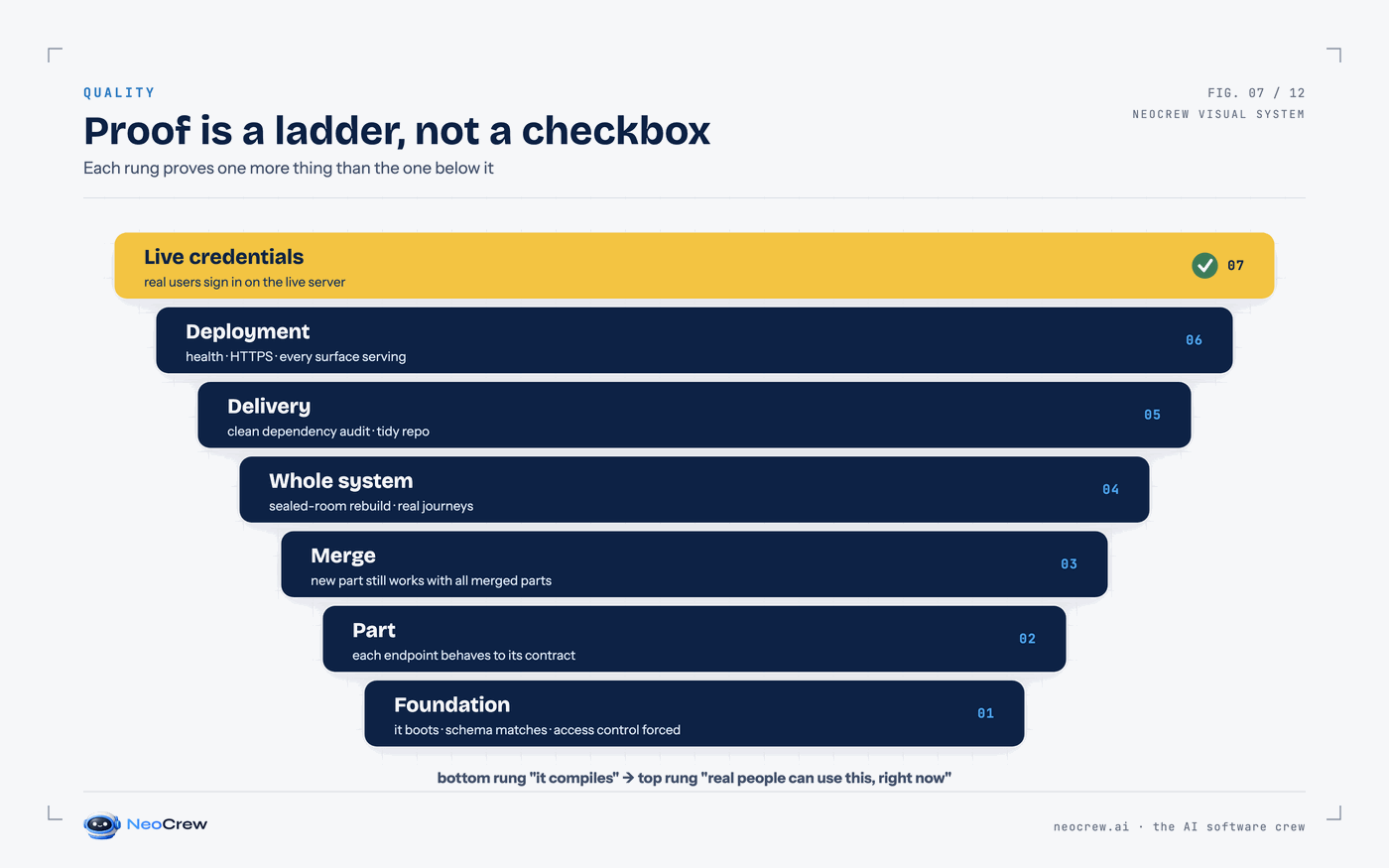
Proof isn’t a checkbox. It’s a ladder, and each rung proves something the rung below it couldn’t. Here’s how NeoCrew climbs it.
Why isn’t “the build is green” enough?
Think about everything a green pipeline doesn’t tell you.
It doesn’t tell you the parts still work together once combined. It doesn’t tell you a real browser can render the screen a user actually sees. It doesn’t tell you sign-in works against the live infrastructure, with real sessions and real email. It doesn’t tell you the app does the thing it was for, only that the code it contains didn’t throw where someone thought to check.
A green pipeline is a necessary signal. It is nowhere near a sufficient one. The gap between the two is exactly where “it passed but it’s unusable” lives, and it’s a gap you can only close by proving more things, in more realistic conditions, the closer you get to a real user.
What is a ladder of proof?
Instead of one big “tests pass / tests fail” verdict, NeoCrew uses a sequence of gates, each scoped to prove exactly one kind of thing. Lower rungs are fast and foundational; higher rungs are slower, more realistic, and closer to the real world. You can’t skip a rung, and a failure is attributed to the thing that caused it.
| Gate | Scope | What it proves |
|---|---|---|
| Foundation | The scaffold | The app boots, the schema matches, anonymous requests are rejected, row-level security is forced |
| Part | One unit of work | Each endpoint behaves to its contract against a live app with realistic data |
| Merge | A part + everything already merged | The new part still works alongside the parts it can affect |
| Whole system | The assembled app | Every surface boots and real user journeys run end to end in a sealed room |
| Delivery | The repository | A clean dependency audit and a tidy, deployable codebase |
| Deployment | The live environment | Health, HTTPS only, every surface serving and rendering |
| Live credentials | The running product | Real throwaway users complete real sign-in, a media round-trip, and a live AI answer |
Read top to bottom, it’s a story: it boots, each part is correct, the parts coexist, the whole thing works, the repo is clean, the deploy is healthy, real people can actually use it. Every rung is a claim you’d want to be true before you tell a customer it’s done, and most pipelines only ever check the first two.
How does a single part get proven?
Before the whole app can be trusted, each part has to earn its place. In NeoCrew, a part is built by an agent in an isolated sandbox, but, as covered in our companion piece on why an AI can’t grade its own homework, the verdict never comes from the builder.
When the builder claims done, the authoritative suite runs in a clean room: a fresh environment, the exact committed code, fresh random data. Pass, and the part moves to review and a merge check, where it must still work alongside everything already merged, one merge at a time, so a part that breaks its neighbours never lands. Fail, and it goes back. The part rung and the merge rung together guarantee that the app is never quietly broken by the act of adding to it.
What does the sealed-room system test actually do?
Here’s the rung that catches what unit tests never will.
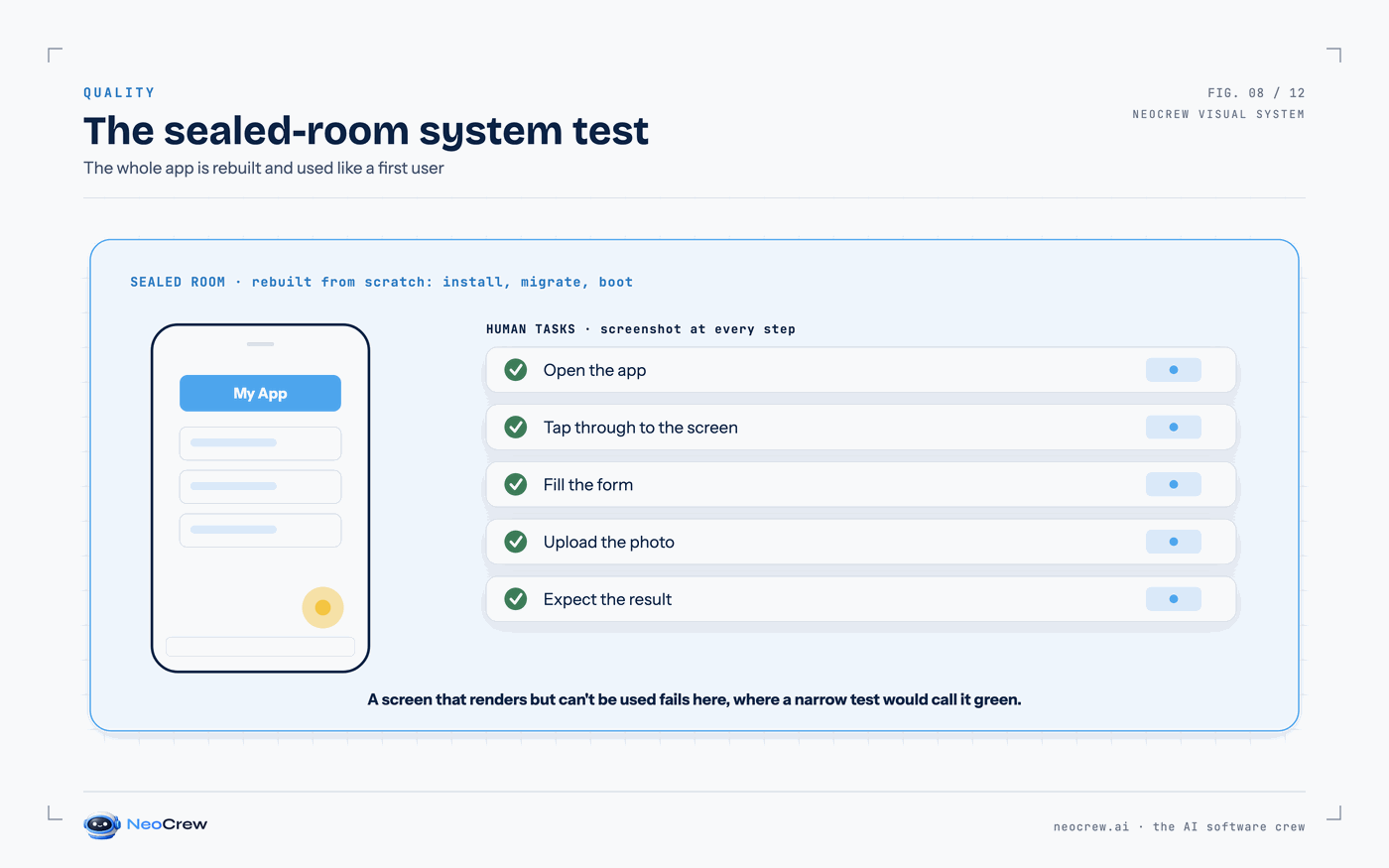
Once every part has merged, the entire application is rebuilt from scratch in a sealed room, installed, migrated, booted, as if for the first time on a clean machine. Then every suite is re-run together, and real user journeys are walked in a real browser, signed in and signed out.
The part that matters most: a test drive performs genuinely human tasks. Not assertions in a test file, actual tasks, the kind a first user would do. Open the app. Tap through to the screen. Fill the form. Upload the photo. Expect the result. A screenshot is captured at every step. A screen that renders but can’t be used, a tab that goes nowhere, a button wired to nothing, a list that’s permanently empty, fails here, where a narrower test would have called it green.
Why prove it again on the live server?
A product that works in a sealed room is still not a product that works in the world. The live environment has its own realities: real HTTPS, real sign-in infrastructure, real email delivery, real sessions, real keys.
So after deployment, two more rungs run. First, the live app is probed from the outside: it must serve over HTTPS with no downgrade, reject anonymous requests to protected paths, and render its sign-in screen in a real browser. Then the top rung, the one most pipelines never reach, real throwaway users drive the live product: they try bad emails, weak passwords, unknown accounts, and wrong codes, and then sign in successfully; they complete a media round-trip; they get a live AI answer through the product’s own configured key.
Only when that top rung is green does “deployed” mean deployed. Not “the deploy command succeeded”, real people can actually use this, right now, on the real server.
Why attribute each failure to the thing that caused it?
A ladder of gates only works if a failure points you at the right rung. Otherwise you get the most demoralising experience in software: a red light somewhere, no idea which change caused it, and a team bisecting history by hand.
So failures are attributed to the part that caused them, not dumped as a generic “the build is red.” When a merge check fails because a newly added part broke something, the failure is routed to the part responsible, not to the innocent part whose test happened to catch it. The signal that comes back isn’t “something, somewhere, is wrong”; it’s “this part, against this expectation, in this way.”
That precision is what lets the higher rungs stay fast and fearless. You can keep adding parts, confident that if adding one breaks the whole, the ladder will tell you exactly which one, and send the fix to exactly the right place.
What does a test drive catch that unit tests never will?
Unit tests and contract tests answer a precise question: does this code do what its contract says? That’s essential, and it’s also not the same question as can a human actually get something done in this app?
Consider the failures that live in the gap between those two questions:
- A navigation tab that renders but is wired to nothing, so tapping it goes nowhere.
- A form that submits successfully to an endpoint that works, but the screen never tells the user it worked, so they submit three more times.
- A list view that passes every data test because the query is correct, but ships permanently empty because nothing ever populates it.
- A button that’s present, styled, and dead.
Every one of these can pass a narrow test suite with flying colours. Every one of these makes the product unusable for a real person on day one. A unit test checks that the wire carries current; a test drive checks that the light actually turns on when you flip the switch.
That’s why the sealed-room test drive performs genuinely human tasks and captures a screenshot at every step. It’s not measuring whether the code threw an error. It’s measuring whether a first-time user, handed this app cold, can do the thing the app exists to let them do. A screen that renders but can’t be used doesn’t clear this rung, which is exactly the verdict a narrower test could never reach.
Can these gates be gamed?
This is the question that separates real quality architecture from theatre, and the answer is structural, not aspirational.
- The builder never writes the tests it’s judged against, they’re generated from the contract.
- The builder can’t see or edit the suite.
- Verdicts come only from a clean room, never the builder’s environment.
- Function and security are judged by different models, so neither can quietly excuse the other.
- The highest rungs run after deploy, against reality, which no amount of clever local coding can fake.
A builder can be brilliant and still not be able to cheat, because the things that would let it cheat, writing the exam, reading the exam, running the exam in its own room, have all been designed out.
Demo versus proof
The industry has trained us to accept the demo as evidence. A demo is a happy path, performed once, by the person who built it, under conditions they chose. It proves the thing can work. It says nothing about whether it does work for a stranger on day one.
| A demo | The ladder of proof | |
|---|---|---|
| Who runs it | The builder | Independent gates and real test users |
| How many paths | One happy path | Every part, every journey, failure cases included |
| Where | The builder’s setup | Clean room, sealed room, and the live server |
| What it proves | It can work, once | It does work, for a real user, right now |
Proof is more work than a demo. That’s the entire point. The extra rungs are exactly the distance between “look what it can do” and “you can rely on this.”
See the whole ladder in action on your own idea, the first look is free.
Keep reading
- Why your AI coding agent can’t grade its own homework
- Idea in, live app out: what you actually get from NeoCrew
- AI Writes the Code. Nobody Proves It Works. So We Built the Team That Does Both.
- AI App Maintenance After Launch: A 2026 Checklist
Build your idea with NeoCrew
Have an idea? Describe it and get a free first look in under a minute. NeoCrew’s crew of AI specialists carries it from idea to a live, proven app, with you approving each step. You ship work, not seats.
Frequently asked questions
What are software quality gates?
Quality gates are checkpoints in a build and release process, each proving a specific property before work proceeds, for example, that the app boots, that each component meets its contract, that the assembled system works end to end, and that the deployed product is usable by real users.
Why isn’t a passing CI pipeline enough to ship?
A green pipeline proves the code compiled and certain tests passed. It doesn’t prove the parts work together in a real browser, that sign-in works against live infrastructure, or that a real user can complete a real task. Those require higher, more realistic gates.
What is a sealed-room system test?
The entire application is rebuilt from scratch in a clean environment, every suite is re-run together, and real user journeys are walked in a real browser, including human tasks like filling forms and uploading files, with a screenshot at each step.
What does NeoCrew verify after deployment?
The live app is probed from outside (HTTPS, protected paths, rendering) and then real throwaway users complete real sign-in, a media upload round-trip, and a live AI answer on the running server. Only then is it considered deployed.
What’s the difference between a demo and real proof?
A demo is one happy path, performed once by the builder under chosen conditions, it proves something can work. Proof covers every part, every journey, and failure cases, run by independent gates and real test users in clean, sealed, and live environments, it proves the product does work for a real user, right now.
Why isn’t a passing demo enough to ship to customers?
A demo shows the intended path succeeding in ideal conditions. It says nothing about untested paths, real infrastructure, concurrent users, or a first-timer who taps the wrong thing first. The higher rungs of the ladder exist precisely to close the gap between “it can work” and “it does work in the world.”