
Case study · Consumer fashion tech
AI wardrobe stylist
An AI-native styling app that turns your own wardrobe into a personal stylist.
- Client
- Consumer fashion-tech venture
- Scope
- Discovery to launch
- Sector
- Consumer fashion tech
- Platform
- iOS, Android and web admin
At a glance
What was delivered
Photos in, a tagged closet out. The step that kills most wardrobe apps is gone.
Two use models, two deliberately do not, for speed and cost.
Each look is rendered once and served to everyone who shares that body type.
iOS and Android for users, a web platform for the team.
The challenge
A wardrobe full of clothes and nothing to wear
Fashion discovery is broken in a specific way. People are flooded with inspiration on social feeds, but almost none of it accounts for who they are, what suits them or what they already own.
Existing wardrobe apps make it worse before they make it better. Most ask users to enter every item by hand, one at a time, which is tedious enough that people give up. The ones that do organize a closet stop at a grid of flat images. They do not style, they do not show a look on a body, and they do not connect what you own to what you could buy.
The client's brief was the opposite: styling that feels effortless from the first photo, personal to each user's body and taste, and commercially viable through affiliate shopping, without the data entry that kills adoption.
The app should do the work, not the user.
The solution
Three capabilities carry the whole experience
Around them sits a light layer of motivation and commerce: a gamified style score that rewards styling, and shoppable looks that turn inspiration into affiliate revenue.
An effortless closet
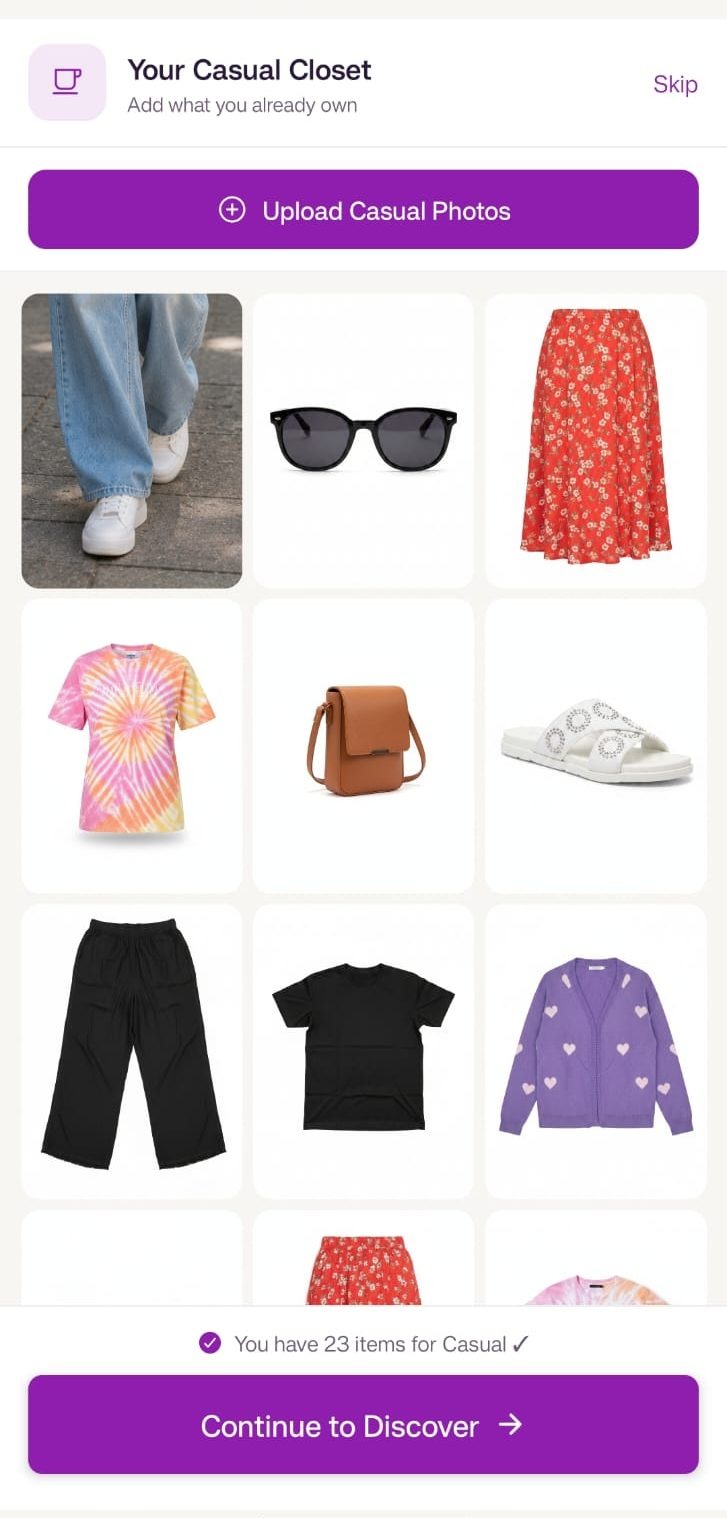
The user photographs their clothes. Computer vision detects each garment, tags category, color, pattern and formality, and files it. No manual entry.
A personalized feed
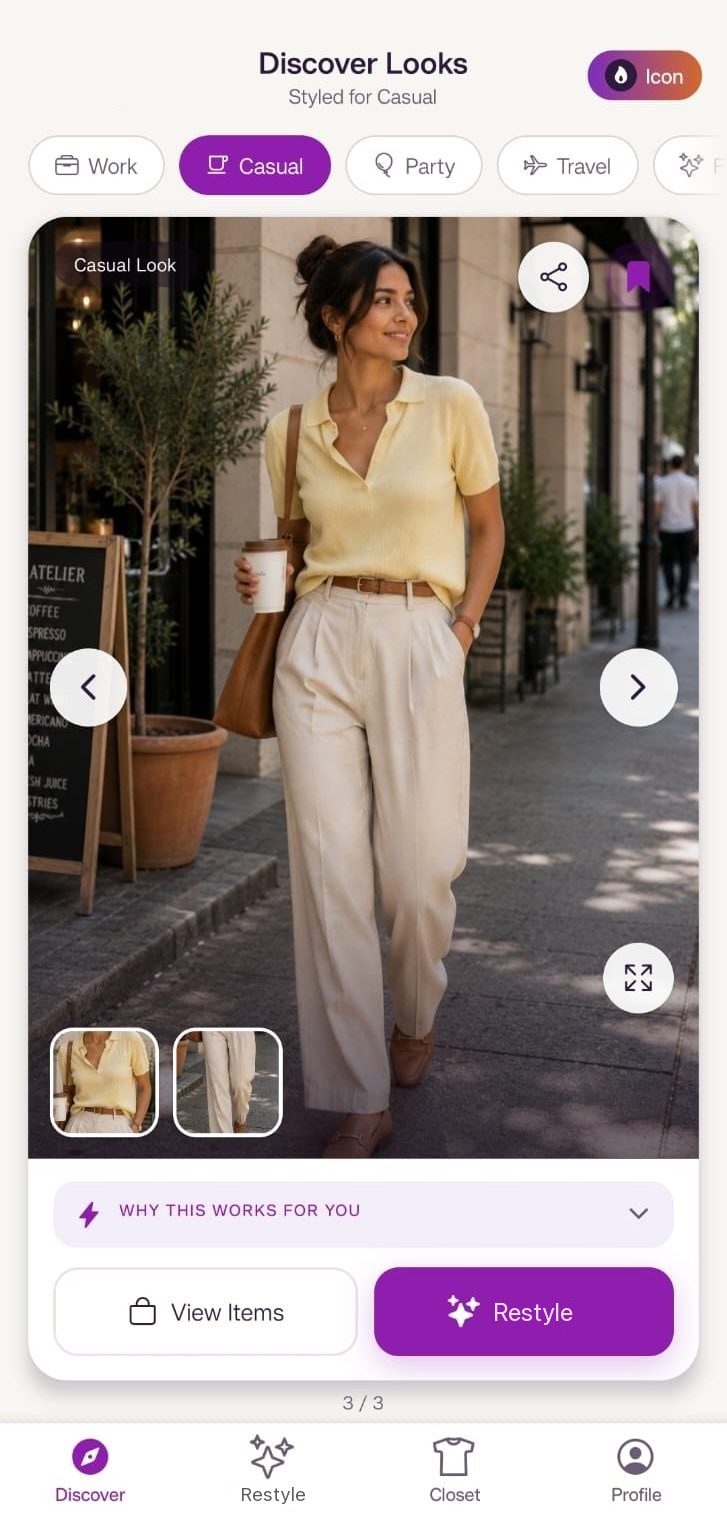
Looks are filtered by gender, body type and occasion, then ranked by how many pieces the user already owns and how well they match preferred brands.
A styling playground
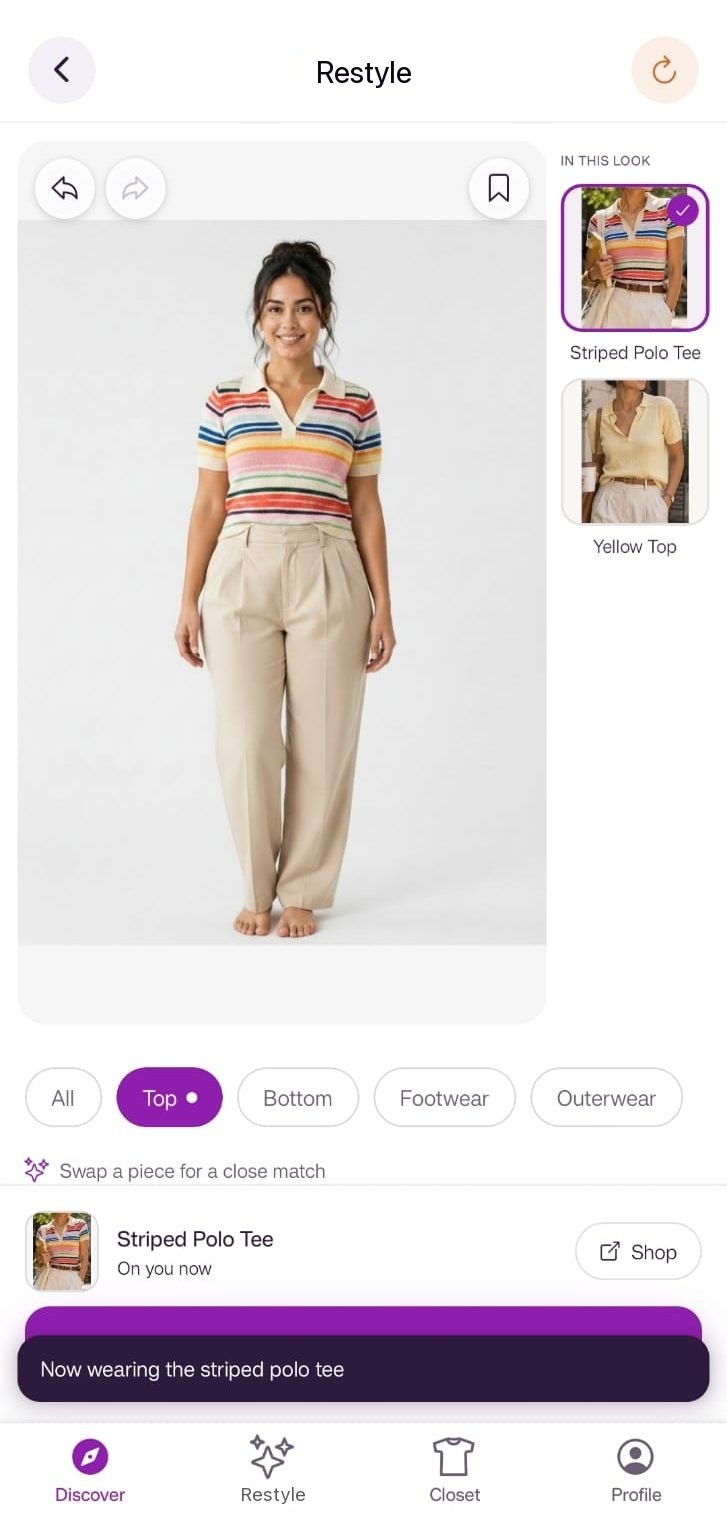
Swap your own pieces, or new branded ones, onto a model matched to your body type, and see the outfit re-render on the spot.
The first minute
Value before the app asks for anything
New users pick their gender, body type, favorite occasions and brands, then add a few closet photos. Body type is handled with care, with distinct options for women and men, because it drives everything the feed shows next. The moment onboarding ends, the feed is already theirs.
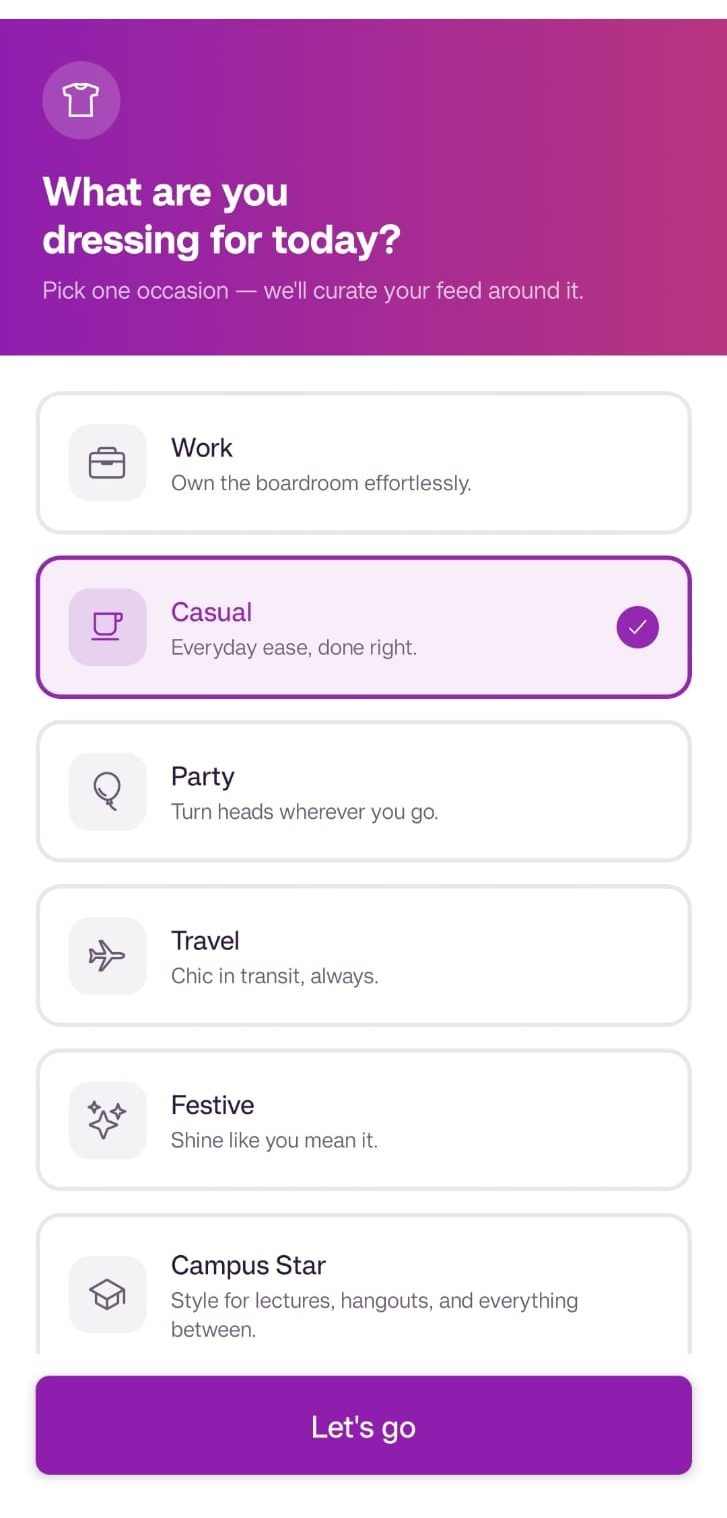
Pick an occasionWork, casual, party, travel, festive, campus. The feed is curated around the choice.
Photograph the closetGarments are detected and tagged from photos. The count updates as pieces land.
Land on your feedEvery look card says how many of its pieces you already own.
Restyle
The question every inspiration image leaves open: what would this look like on me?
Restyle is where the app stops being a feed and becomes a stylist. The user picks a look and restyles it slot by slot, top, bottom, footwear, outerwear, swapping in pieces from their own closet or from the shoppable catalog. The outfit re-renders on a model matched to their body type.
Every generated image is cached, so undoing a change or revisiting a look costs nothing. Anything the user does not own yet is one tap from the shop.
Inside Restyle
Swap a piece. See it on you.
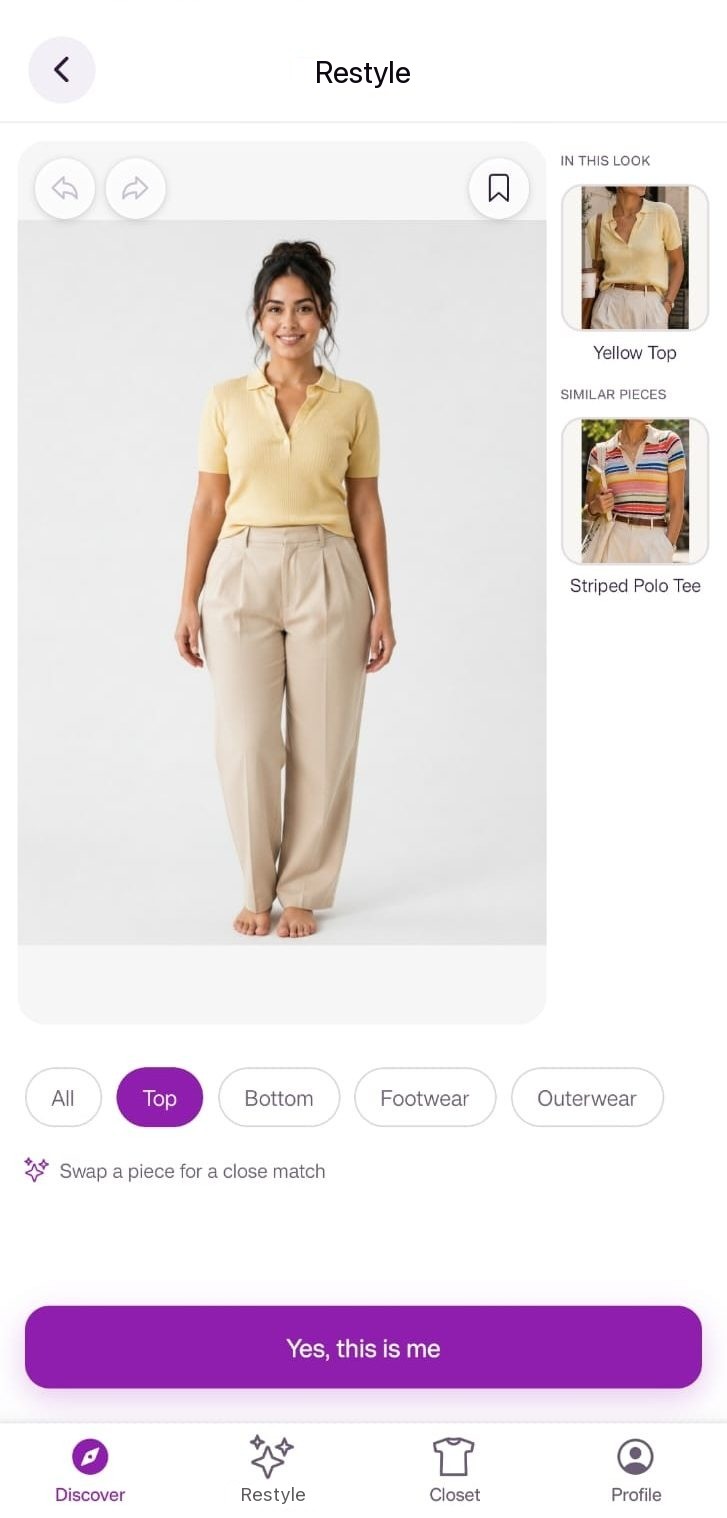
Pick a slotTops, bottoms, footwear, outerwear. Similar pieces are suggested alongside.
Swap and re-renderThe model wears the new piece. Anything you do not own links to the shop.
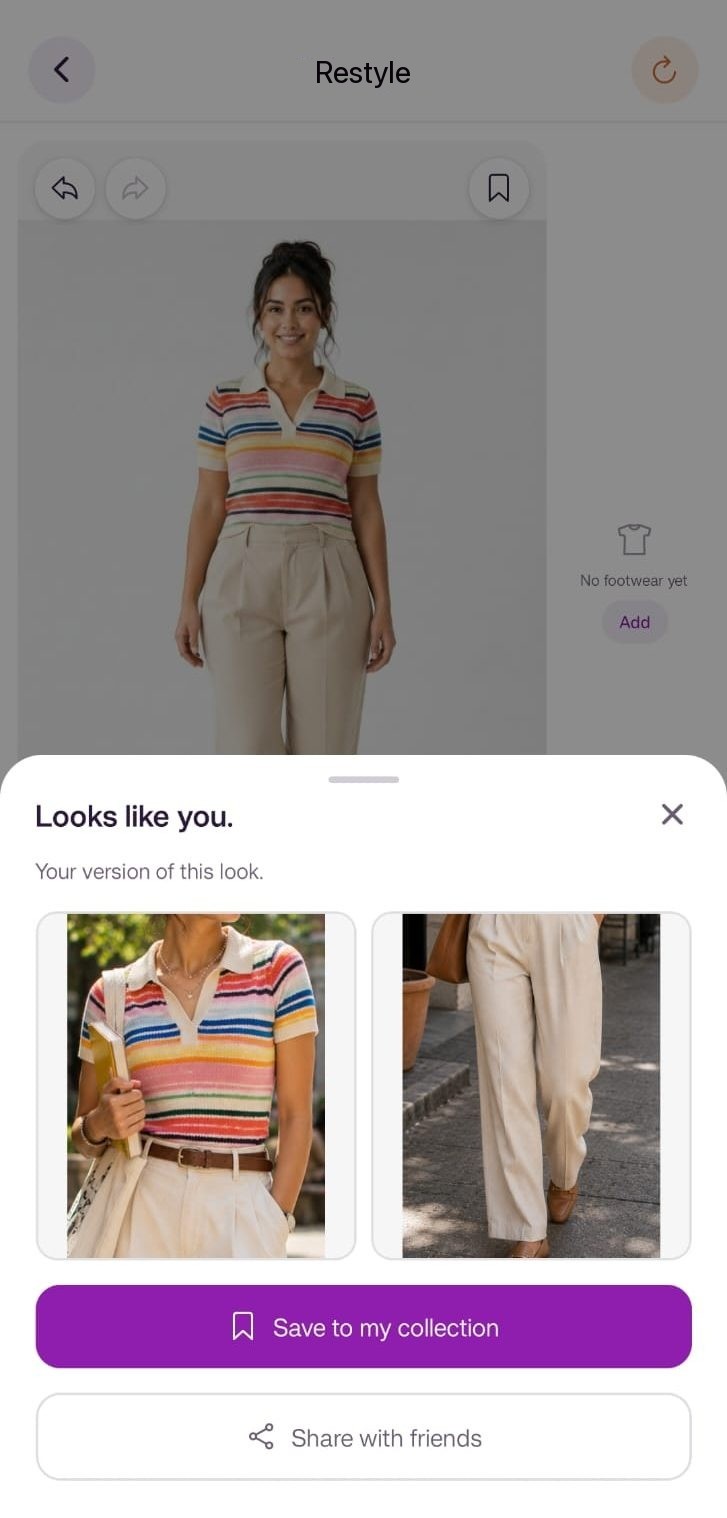
Keep your versionSave it to your collection or share it with friends.
AI integration
AI is the reason the product works, used in four places
The split matters. Heavy AI runs where it creates magic, in understanding photos and generating looks. Lightweight logic runs where speed and predictability matter more, in matching and ranking. That balance keeps the app responsive and the running costs sustainable.
Closet understanding
A vision model reads clothing photos, detects each garment and tags category, subcategory, color, pattern and formality. This is what removes manual entry.
Look and try-on generation
An image-generation model renders styled looks and powers Restyle, dressing a body-type model in the chosen pieces.
Closet matching
A fast, tag-based engine matches a user's items to a look's pieces. Nothing runs a model at match time, so it is instant and predictable.
Feed personalization
Looks are filtered and ranked per user by body type, occasion, closet overlap and brand affinity.
Engineering for scale and cost
The expensive part runs once, not per user
Image generation is the most expensive thing the product does, so the architecture spends as little as possible without the user noticing.
- Looks rendered for a body type are generated once and served to every user who shares that body type
- Every generated image is cached, so revisiting a look or undoing a change is free
- Usage is metered against clear monthly limits that protect margins while staying generous for how people actually use the app
The data model is deliberately small: products, looks, closet items, base models and cached renders, on standard, proven infrastructure. Nothing exotic, which keeps it maintainable and ready to scale.
The catalog is tagged by people, matched by machine. Human curation sets the taste; the system does the personalization.
The admin platform
A styling app is only as good as its catalog
The client's team runs the whole product from a purpose-built web platform, with no engineering needed day to day. It manages two connected things, designed for a non-technical team to operate at scale.
Products
Individual branded garments, each tagged with the full set of attributes the matching engine relies on.
Looks
Complete outfits built from those products, enriched with occasions, body types, seasons and short styling notes written for each body type.
Lifecycle and safeguards
Brand management, a draft to published to archived lifecycle, and protection against deleting items still in use.
The business model
Two ways to earn, one feature set
Shoppable looks drive affiliate revenue when users buy the pieces they do not own yet. A subscription unlocks more styling capacity across three tiers, priced for the Indian market. Every plan shares the full feature set; tiers differ only by monthly styling capacity, which keeps the free tier genuinely useful as an acquisition engine.
Free
No cost
Enough to build a small closet and feel the magic.
Plus
Monthly or annual
Everyday styling capacity.
Pro
Monthly or annual
For the most engaged users.
How it was built
Blank page to launch-ready, as one piece of work
The app was delivered on NeoCrew. A team of specialist AI agents worked alongside human approval gates at every stage, which is how design, architecture, the admin platform and the AI systems arrived as one coherent whole rather than four hand-offs.
Discover
The product thesis: effortless closet, body-aware feed, try-on, and how the economics work.
Design
Onboarding, feed, Restyle, the style score and the admin, designed as one system.
Blueprint
The AI split, the render cache and the small data model, signed off before build.
Build
The iOS and Android app, the admin platform and the AI systems, delivered together.
Specialist AI agents do the drafting at every stage. Humans approve each gate before anything moves on, and the same team keeps operating the product after launch.
In the founder's words
Something tangible, finally
I'm thrilled to finally have something tangible in my hands. The design was perfect, and I have no concerns at all. The attention to detail, the support, and the genuine love for the product made all the difference. I couldn't be more excited for what comes next.
The outcome
A coherent product thesis, executed end to end
The app went from concept to a complete, launch-ready product. The effortless closet removes the friction that sinks most wardrobe apps, the body-type-aware feed and try-on make it personal, and the architecture lets the product grow without the AI costs growing with it.
- A complete iOS and Android styling app, from onboarding to try-on to checkout
- An AI closet pipeline that removes manual data entry entirely
- A body-type-aware feed with owned-item matching
- Restyle, an interactive try-on playground
- A non-technical admin platform for catalog and brand management
- A subscription and affiliate model with unit economics built to scale
What it's made of
The moving parts
Questions
AI wardrobe stylist, answered
What is the product?
An AI-native fashion styling app for iOS and Android. It builds your closet from a few photos, shows you looks that suit your body type and occasion, and lets you restyle them on a model matched to your body type.
Who was the client?
A consumer fashion-tech venture, which brought the vision. The product was taken from a blank page to a launch-ready app, covering design, architecture, the admin platform and the AI systems.
Do users have to enter their clothes by hand?
No. Users photograph their clothes and a vision model detects each garment and tags its category, subcategory, color, pattern and formality automatically.
How does the app keep AI costs under control?
Heavy AI runs only where it matters, in reading photos and generating looks. Looks are rendered once per body type and shared, every render is cached, and usage is metered against monthly limits. Matching and ranking use fast tag-based logic with no model at runtime.
How does the app make money?
Two ways: affiliate revenue from shoppable looks, and a subscription with Free, Plus and Pro tiers priced for the Indian market. Every tier has the full feature set; they differ only by monthly styling capacity.
How was the app built?
On NeoCrew, through Discover, Design, Blueprint and Build, with specialist AI agents doing the production work and human approval gates at every stage.
Keep reading
More built on NeoCrew

UAE credit card matchmaker
A UAE credit card matchmaker: spending in, top three cards out, sent to WhatsApp. No login anywhere in the path.
Read the case study
Predictive fishing intelligence
An offline-first AI copilot that tells trawler captains where the fish will feed tomorrow. Brief to client-ready in under two weeks.
Read the case studyYour turn
Have a product where the app should do the work?
Tell us what you are building. NeoCrew turns the idea into a product requirements document in one business day, free.