
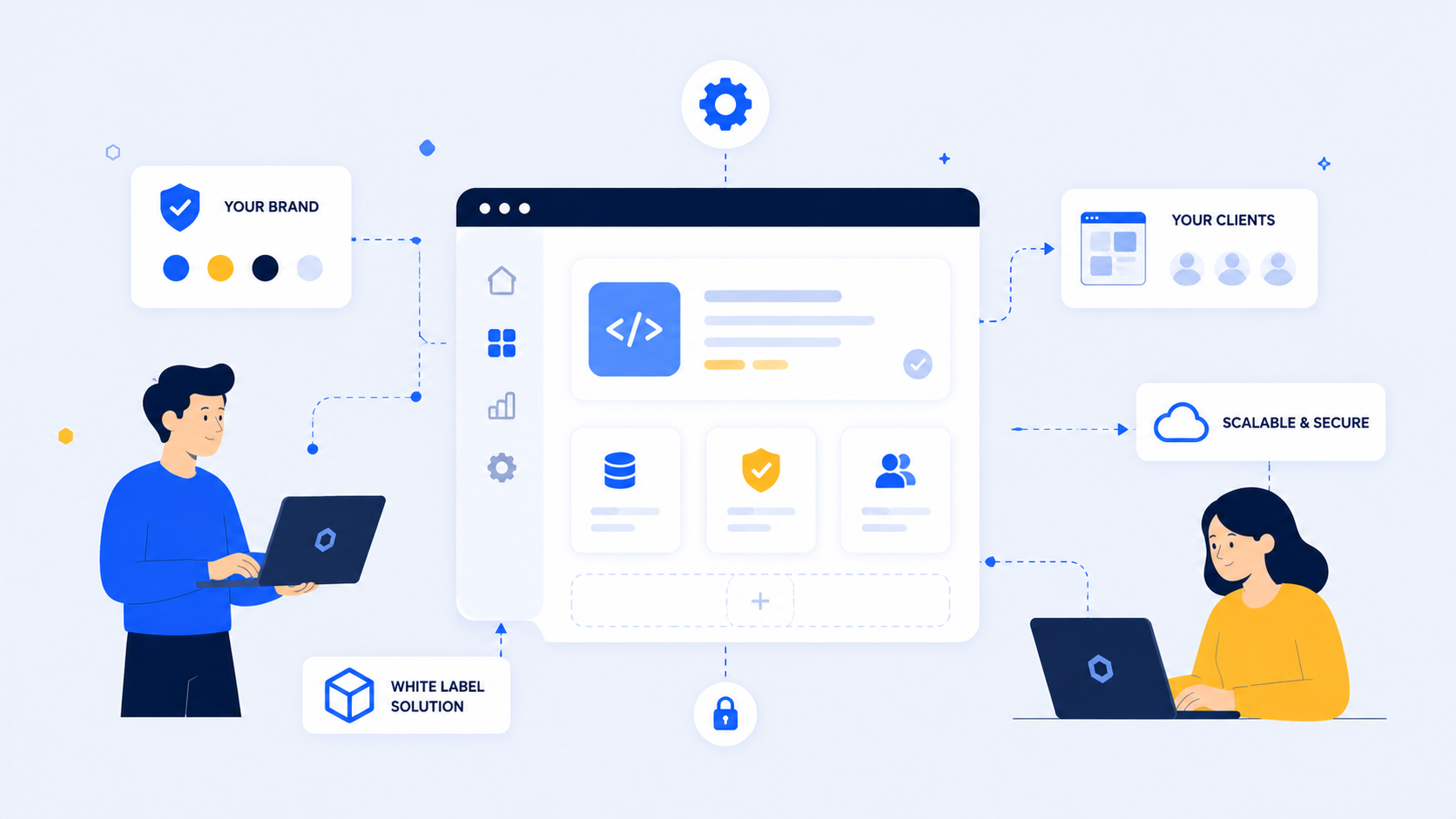
Your client wants a SaaS platform with a billing engine, a mobile app to go with it, and two API integrations into tools you have never touched. You sell strategy and design. You do not have a backend team, and hiring one for a single project is how agencies go broke. So you have two options. Turn the work away, or have someone build it under your name. Most agencies pick the second. Few do it well, because they treat white label software development as a vendor transaction instead of a delivery partnership.
This guide is the operator’s version. What the model is, what a partner can build, what it costs, how the process runs, who owns the code, where the risks are, and how to choose a partner you can put your brand on.
What White Label Software Development Actually Is
White label software development is not buying a pre-built product and putting your logo on it. It is having custom software built by a partner and delivered under your brand, so the client sees your agency and never the people who wrote the code.
That distinction matters because it changes everything downstream. A pre-built product locks you into someone else’s roadmap. Custom white label software development builds exactly what your client briefed, on their stack, owned by them on delivery. You stay the agency of record. The partner stays invisible.
This model covers full software builds: applications, platforms, and integrations your team could not staff for even if you wanted to. If your work is specifically web application builds, our related guide on white label web development covers that slice in more depth. Both are the same model. This one is the broader view across software categories.
Who White Label Software Development Is For
This model fits a specific shape of agency:
- Marketing and creative agencies that win software projects inside larger retainers but run no engineering team.
- Design studios that sell the product vision and need someone to build it properly.
- Digital agencies asked to deliver across more stacks than they can reasonably hire for.
- Freelancers and small shops scaling up who have more work than hours and do not want to become a manager overnight.
- Established agencies at capacity that do not want to turn down a good client during a busy quarter.
If you sell software outcomes but building all of it in-house would mean hires you cannot justify, this model is for you.
What Agencies Commission From a White Label Partner
The reason agencies reach for this model is range. A capable partner builds across categories you would otherwise decline. Look for your client’s use case here:
- SaaS platforms with auth, billing, multi-tenancy, and admin tooling.
- Mobile apps for iOS and Android, native or cross-platform.
- Client portals where your client’s customers log in, see their data, and self-serve.
- Custom dashboards that pull from multiple sources and report in real time.
- Fintech tools with payments, ledgers, and compliance-aware flows.
- Enterprise internal tools that replace spreadsheets and manual ops.
- API integrations that wire a client’s existing systems together.
- Ecommerce back-ends for catalog, inventory, fulfillment, and checkout logic.
A concrete example. A branding agency wins a retainer with a logistics client who needs a driver app, a dispatch dashboard, and an integration into their existing ERP. The agency has designers, not engineers. They scope it, hand the build to a white label partner, review at each checkpoint, and ship the whole thing under their own name. The client never knows a second company existed. That is the model working as intended.
What It Costs and How Agencies Price It
Costs depend on scope, but for agency-grade custom software a typical white label software development project runs roughly $30,000 to $50,000. A small defined tool sits at the lower end. A multi-part build with a platform, an app, and integrations sits at the top, or beyond it.
What drives the number is scope, not vendor greed: how many surfaces (web, mobile, admin), how many integrations, how much compliance work, and how tight the timeline. Fewer surfaces and a looser deadline cost less.
The margin sits with you. Agencies commonly mark up white label work 30 to 60 percent. You set the client-facing price, pay the partner theirs, and keep the spread. You are pricing the relationship, the strategy, and the accountability, which is the part that carries real value to the client.
What You Need Ready Before You Engage a Partner
A partner can only move as fast as your inputs let them. Before you bring one in, have these ready:
- A clear client brief. Outcomes, must-have features, the deadline, the budget.
- Brand and design assets if the deliverable ships under your identity.
- Access to any existing systems the build must integrate with.
- A single point of contact on your side who can answer questions and approve at checkpoints.
- The legal set started: NDA, white label agreement, IP transfer (covered below).
The agencies that get burned skip this and expect the partner to fill the gaps. The partner cannot read the client’s mind. You can.
How the Process Works
Here is the flow from the agency’s side. Six steps. None are optional.
- Scope with the client. Pin down what they actually need before you talk to anyone. Outcomes, must-have features, deadline, budget. You own this conversation.
- Brief the partner. Hand over a tight written brief. Goals, scope, stack preferences, edge cases. This is where quality is won or lost.
- Sign the NDA and white label agreement. Before code, before access. This protects your client relationship and locks the partner’s invisibility into writing.
- Build with checkpoints. The partner builds in stages and shows working software at each one. You review against the brief, not a status email.
- QA against the brief. Test what was promised, line by line. Not “does it run,” but “does it do what the client paid for.”
- Brand and deliver. The work ships under your name. Then offer ongoing support if the client wants it.
The agencies that struggle skip steps 2 and 4. They send a vague brief and then go quiet until delivery. A loose brief gets you software that technically matches the words and misses the intent. No checkpoints means you discover the gap when it is most expensive to fix. Write the brief. Show up at the checkpoints.
How Long It Takes
Timelines track scope. A small, well-defined build can move in a couple of weeks. A larger multi-part platform takes longer. With a structured, agent-assisted team and human review at each checkpoint, many builds that take a traditional shop six to ten weeks land in roughly two to four. Always ask a partner for a specific number of weeks for a build like yours. A partner who knows their throughput gives you a number. One who does not gives you an adjective.
Benefits for Agencies
The case for white label software development is margin and capacity, not “cost savings.” The real wins:
- Take on projects you cannot staff for. A software brief stops being a reason to lose the client. It becomes revenue you keep.
- Expand what you sell. Add SaaS, mobile, and integrations to your menu without hiring a single engineer or carrying their salary between projects.
- Say yes on the call. Capacity stops being your ceiling. You scope the work in the room instead of going back to check who is free.
- Protect your margin. You price the project, the partner delivers under it, and the spread is yours. No idle senior engineers eating payroll between deals.
- Open recurring revenue. Maintenance and support retainers turn a one-time build into monthly income. The partner keeps the lights on, invisibly. You keep the relationship and the invoice.
The Risks, and How to Manage Them
This model is not free of downside. Know the failure modes before you sign, because they are all manageable:
- A vague brief produces the wrong build. The fix is on you: scope tightly and put it in writing.
- A partner who goes quiet between checkpoints. Insist on staged reviews of working software, not status emails.
- Confidentiality leaks or client poaching. Contractual, not hopeful: NDA, white label agreement, and a non-solicitation clause, all signed before access.
- Quality you cannot vouch for. Vet the partner before the first real project, ideally with a small paid test build.
- Re-onboarding cost. A partner who restarts from zero each project quietly taxes every engagement. Pick one that retains context across builds.
White label software development goes wrong when an agency treats it as fire-and-forget. It goes right when you stay the owner of the brief and the client relationship and let the partner own the build.
NDA and IP Ownership
This is where agency owners hesitate, so let us be direct.
Does the partner keep the code? No. Under a proper white label software development agreement, IP transfers to you or your client on delivery and final payment. The partner builds it. They do not own it.
Will your client ever find out? No. The NDA and white label agreement bind the partner to invisibility. They do not contact your client, do not appear in the deliverable, and do not claim the work. A non-solicitation clause stops them from going around you.
What protects the relationship? Three documents working together. The NDA covers confidentiality. The white label agreement covers branding and invisibility. The IP transfer covers ownership. Sign all three before any code is written. A serious partner offers these as standard, not as something you have to ask for.
How to Choose a White Label Software Development Partner
This is the high-stakes part. The wrong partner shows up as your failure in front of your client. Vet for these:
- Tech stack coverage. A real partner covers frontend, backend, mobile, and integrations, not one narrow framework.
- Case studies with third-party validation. Named outcomes and references you can verify, not a wall of logos.
- NDA and white label policy upfront. Standard and offered, not something you have to push for.
- A specific turnaround number. Ask how many weeks for a build like yours. A number, not an adjective.
- Whether they get faster the more you work together. A good partner learns your stack, your standards, and your clients, so your third project runs faster than your first. If every project means re-onboarding from zero, you are renting a stranger each time.
That last point is the difference between a vendor and a partner. Vet for it.
How NeoCrew Delivers White Label Software Development
NeoCrew spins up a full product team per project. Business analysis to pin the brief. Design. Architecture. Frontend and backend development. QA against what was promised. Each role hands off to the next in a structured flow, so nothing falls between seams. Under each role, specialized agents run the work at scale, with a human reviewing at every step. That structure is why many builds that take a traditional shop six to ten weeks land in two to four with us.
The compounding part is NeoBrain. Every project trains the system on your stack, your standards, and your clients’ patterns, so the work gets faster and more accurate each cycle. You are not re-explaining who you are on project two.
Your third project with us is faster than your first.
Frequently Asked Questions
What is white label software development?
White label software development is when an agency has custom software built by an outside partner and delivers it to the client under the agency’s own brand. The client sees the agency. The partner stays invisible. It is not a pre-built product with a new logo. It is custom work built to the brief and owned by the agency or client on delivery.
How much does white label software development cost?
For agency-grade custom software, projects typically run about $30,000 to $50,000 depending on scope. A small, single-surface tool sits at the lower end; a multi-part build with a platform, mobile app, and integrations sits at the top or beyond. Scope, number of surfaces, integrations, and timeline drive the figure. Agencies commonly mark the work up 30 to 60 percent to the client.
Who owns the code?
You do, or your client does. Under a standard white label software development agreement, intellectual property transfers to you or your client on delivery and final payment. The partner builds the software but does not retain ownership of it.
Will my client find out I used a white label partner?
No. The NDA and white label agreement bind the partner to confidentiality and invisibility. They do not contact your client, appear in the deliverable, or claim the work. A non-solicitation clause prevents them from approaching your client directly. The work ships entirely under your brand.
What kinds of software can a white label partner build?
A capable white label partner builds SaaS platforms, iOS and Android mobile apps, client portals, custom dashboards, fintech tools, enterprise internal tools, API integrations, and ecommerce back-ends. The point of the model is to cover software categories an agency cannot staff for in-house.
How long does a white label software development project take?
It depends on scope. A small defined build can move in a couple of weeks; a larger platform takes longer. With a structured, agent-assisted team, many builds land in roughly two to four weeks against six to ten for a traditional shop. Always ask the partner for a specific number for a build like yours.
What is the difference between white label software development and staff augmentation?
Staff augmentation rents you engineers who work inside your process and under your management. White label software development hands the whole build to a partner who delivers a finished product under your brand. With staff augmentation you manage the people. With white label you manage the outcome.
When should an agency use white label software development?
Use it when a client brief needs software you cannot staff for, when a deadline will not wait for hiring, or when the work is outside your core service but too valuable to turn away. It is less suitable when the build is your core differentiator and you want the engineering capability in-house long term.
How do I know if a white label partner is reliable?
Check four things. Tech stack coverage across frontend, backend, mobile, and integrations. Case studies with verifiable, third-party validation. A standard NDA and white label policy offered upfront. And a specific turnaround number rather than an adjective. A reliable partner also gets faster the more you work together instead of restarting from zero each project.
Send us your next brief and see what two to four weeks looks like.